LOADING ...
In response to evolving domestic opinion, eMedals Inc has made the conscious decision to remove the presentation of German Third Reich historical artifacts from our online catalogue. For three decades, eMedals Inc has made an effort to preserve history in all its forms. As historians and researchers, we have managed sensitive articles and materials with the greatest of care and respect for their past and present social context. We acknowledge the growing sentiments put forth by the Canadian public and have taken proactive actions to address this opinion.
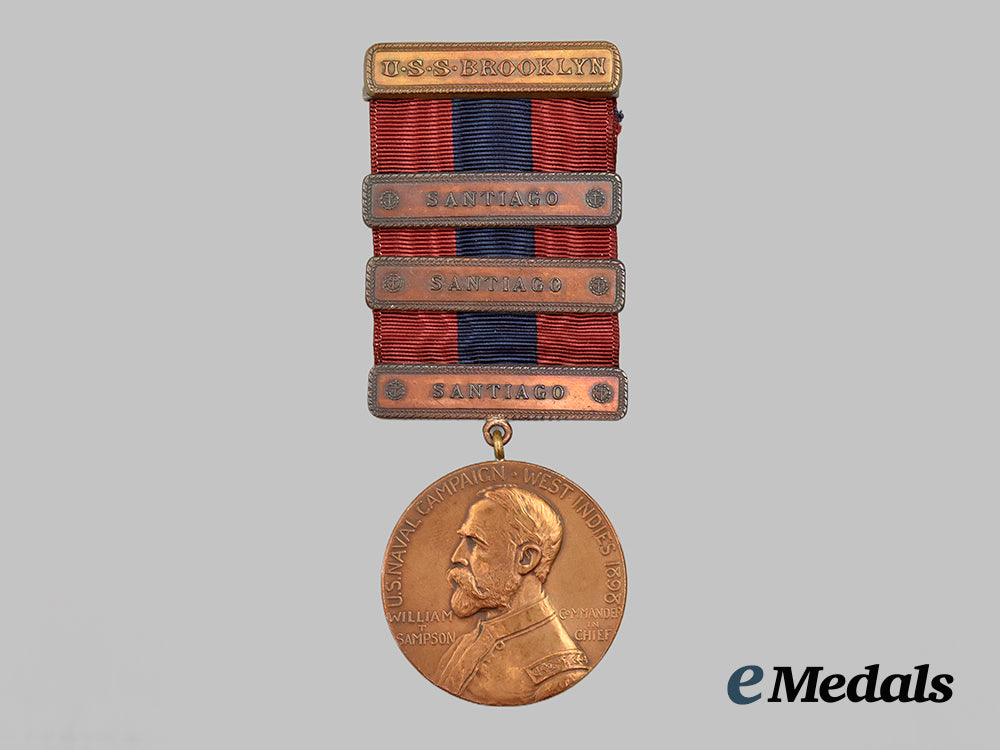
United States. A West Indies Naval Campaign Medal (AKA Sampson Medal), Un-named for the U.S.S. Brooklyn
SKU: ITEM: W7733
Current Bid:
Your Max Bid:
Bid History:
Time Remaining:
Couldn't load pickup availability
Shipping Details
Shipping Details
eMedals offers rapid domestic and international shipping. Orders received prior to 12:00pm (EST) will be shipped on the same business day.* Orders placed on Canadian Federal holidays will be dispatched the subsequent business day. Courier tracking numbers are provided for all shipments. All items purchased from eMedals can be returned for a full monetary refund or merchandise credit, providing the criteria presented in our Terms & Conditions are met. *Please note that the addition of a COA may impact dispatch time.
Shipping Details
eMedals offers rapid domestic and international shipping. Orders received prior to 12:00pm (EST) will be shipped on the same business day.* Orders placed on Canadian Federal holidays will be dispatched the subsequent business day. Courier tracking numbers are provided for all shipments. All items purchased from eMedals can be returned for a full monetary refund or merchandise credit, providing the criteria presented in our Terms & Conditions are met. *Please note that the addition of a COA may impact dispatch time.
Description
Description
3 Clasps - SANTIAGO (all three). In bronze, un-named, the SANTIAGO clasps undated on their reverses, measuring 38.5 mm in diameter, suspended from a 41 mm (w) x 9 mm (h) bar hanger (brooch) inscribed "U.S.S. BROOKLYN" with pinback, very light contact, original ribbon, near extremely fine.
Footnotes:
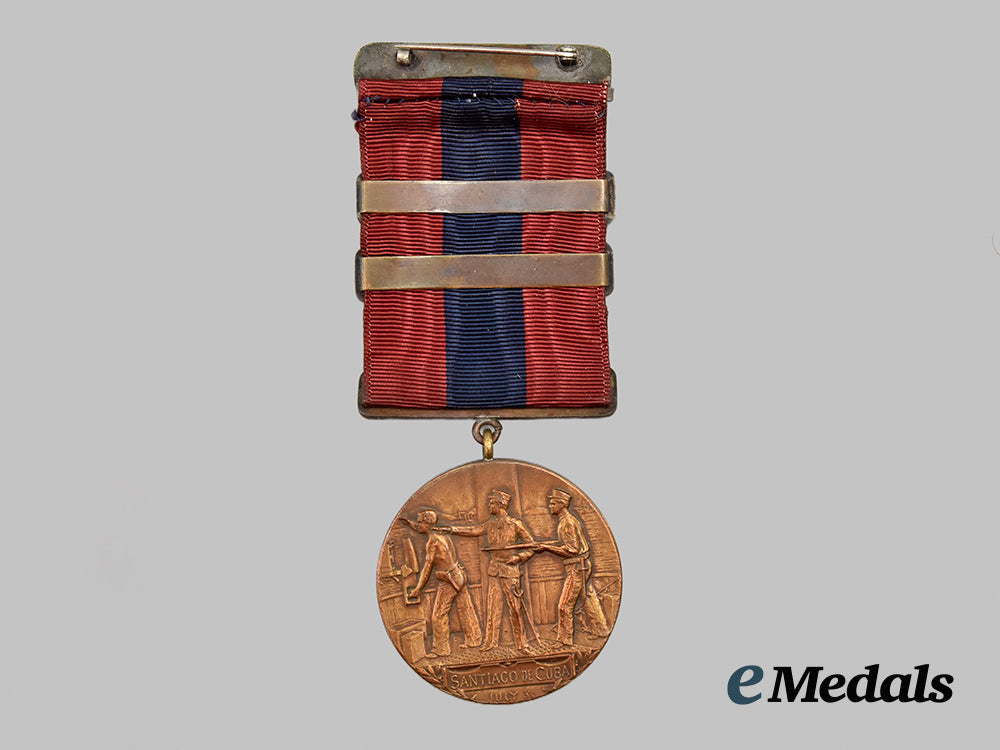
1. The Sampson Medal was a U.S. Navy campaign medal. The medal was authorized by a Joint resolution of the United States Congress on March 3, 1901. The resolution authorized the Secretary of the Navy to have produced bronze medals to commemorate naval engagements in the West Indies and on the shores of Cuba during the Spanish-American War. The medal was to be presented to the officers and men of the United States Navy and Marine Corps who participated in engagements and battles that were deemed to be of sufficient importance to merit their commemoration. It was awarded to those personnel who served on ships in the fleet of Rear Admiral William T. Sampson during combat operations in the waters of the West Indies and Cuba. The resolution also stipulated that those who might be eligible for recognition for participation in more than one engagement would not receive a second medal, but would receive a "bronze bar appropriately inscribed, to be attached to the ribbon by which the medal is suspended." The Sampson Medal was also known as the West Indies Naval Campaign Medal, not to be confused with the West Indies Campaign Medal which was a separate award. A similar commemorative decoration was the Dewey Medal, considered senior to the Sampson Medal. The obverse of the medal was designed by Charles E. Barber. It depicts a bust of Admiral Sampson. The reverse was designed by George T. Morgan. It depicts a Navy officer, Sailor, and Marine standing upon a block identifying the action for which the medal was awarded. Suspending the ribbon of the medal is a brooch pin with the name of the recipient's ship. The recipient's name is engraved on the lower rim of the medal, this being one of only two medals officially issued named to a recipient. Campaign clasps or engagement bars were authorized for wear on the ribbon, showing various battles and the ship name which had participated. The medal was issued for forty-seven engagements or skirmishes and some were awarded with several engagement bars. When worn as a ribbon on a military uniform, there were no devices authorized.
2. The U.S.S. Brooklyn (ACR-3/CA-3) was the third United States Navy armored cruiser, the only one to be named at commissioning for a city rather than a state. Ordered for $3,450,420.29 (hull and machinery), she was launched on October 2, 1895 by William Cramp & Sons Ship and Engine Building Company of Philadelphia; sponsored by Miss Ida May Schieren, daughter of Charles A. Schieren, Mayor of Brooklyn, New York; and commissioned on December 1, 1896, Captain Francis Augustus Cook in command. During the Spanish-American War, the Flying Squadron arrived at Cienfuegos, Cuba on May 21, 1898 and established the blockade of that port. On May 26th, the Squadron arrived at Santiago de Cuba, where the Spanish fleet was being held behind the protection of the forts. Brooklyn was a key vessel in the Battle of Santiago de Cuba on July 3rd, in which the Spanish Fleet was destroyed. Although she was struck twenty times by whole shot, Brooklyn suffered only one man wounded (Fireman J. Bevins) and one man killed (Chief Yeoman George Henry Ellis).
Description
3 Clasps - SANTIAGO (all three). In bronze, un-named, the SANTIAGO clasps undated on their reverses, measuring 38.5 mm in diameter, suspended from a 41 mm (w) x 9 mm (h) bar hanger (brooch) inscribed "U.S.S. BROOKLYN" with pinback, very light contact, original ribbon, near extremely fine.
Footnotes:
1. The Sampson Medal was a U.S. Navy campaign medal. The medal was authorized by a Joint resolution of the United States Congress on March 3, 1901. The resolution authorized the Secretary of the Navy to have produced bronze medals to commemorate naval engagements in the West Indies and on the shores of Cuba during the Spanish-American War. The medal was to be presented to the officers and men of the United States Navy and Marine Corps who participated in engagements and battles that were deemed to be of sufficient importance to merit their commemoration. It was awarded to those personnel who served on ships in the fleet of Rear Admiral William T. Sampson during combat operations in the waters of the West Indies and Cuba. The resolution also stipulated that those who might be eligible for recognition for participation in more than one engagement would not receive a second medal, but would receive a "bronze bar appropriately inscribed, to be attached to the ribbon by which the medal is suspended." The Sampson Medal was also known as the West Indies Naval Campaign Medal, not to be confused with the West Indies Campaign Medal which was a separate award. A similar commemorative decoration was the Dewey Medal, considered senior to the Sampson Medal. The obverse of the medal was designed by Charles E. Barber. It depicts a bust of Admiral Sampson. The reverse was designed by George T. Morgan. It depicts a Navy officer, Sailor, and Marine standing upon a block identifying the action for which the medal was awarded. Suspending the ribbon of the medal is a brooch pin with the name of the recipient's ship. The recipient's name is engraved on the lower rim of the medal, this being one of only two medals officially issued named to a recipient. Campaign clasps or engagement bars were authorized for wear on the ribbon, showing various battles and the ship name which had participated. The medal was issued for forty-seven engagements or skirmishes and some were awarded with several engagement bars. When worn as a ribbon on a military uniform, there were no devices authorized.
2. The U.S.S. Brooklyn (ACR-3/CA-3) was the third United States Navy armored cruiser, the only one to be named at commissioning for a city rather than a state. Ordered for $3,450,420.29 (hull and machinery), she was launched on October 2, 1895 by William Cramp & Sons Ship and Engine Building Company of Philadelphia; sponsored by Miss Ida May Schieren, daughter of Charles A. Schieren, Mayor of Brooklyn, New York; and commissioned on December 1, 1896, Captain Francis Augustus Cook in command. During the Spanish-American War, the Flying Squadron arrived at Cienfuegos, Cuba on May 21, 1898 and established the blockade of that port. On May 26th, the Squadron arrived at Santiago de Cuba, where the Spanish fleet was being held behind the protection of the forts. Brooklyn was a key vessel in the Battle of Santiago de Cuba on July 3rd, in which the Spanish Fleet was destroyed. Although she was struck twenty times by whole shot, Brooklyn suffered only one man wounded (Fireman J. Bevins) and one man killed (Chief Yeoman George Henry Ellis).

You May Also Like
Germany, Wehrmacht. An Eastern Peoples Merit Decoration, I Class in Gold, by Wächtler & Lange
G61790
Germany, HJ. A 1939 National Trade Competition Victor’s Badge, Bronze Grade, by Hermann Aurich
G61789
Germany, Third Reich. An Order Of The German Eagle, Silver Merit Medal, By The Prussian Mint
G61788
Germany, Third Reich. An Order Of The German Eagle, Silver Merit Medal, By The Prussian Mint
G61787
Germany, Kriegsmarine. A High Seas Fleet Badge, Variation 2, by Schwerin
G61786
-
Germany, Wehrmacht. An Eastern Peoples Merit Decoration, I Class in Gold, by Wächtler & Lange
G61790
Add to CartRegular price $285 USDRegular price $0 USD Sale price $285 USDUnit price / per -
Germany, HJ. A 1939 National Trade Competition Victor’s Badge, Bronze Grade, by Hermann Aurich
G61789
Add to CartRegular price $475 USDRegular price $0 USD Sale price $475 USDUnit price / per -
Germany, Third Reich. An Order Of The German Eagle, Silver Merit Medal, By The Prussian Mint
G61788
Add to CartRegular price $625 USDRegular price $0 USD Sale price $625 USDUnit price / per -
Germany, Third Reich. An Order Of The German Eagle, Silver Merit Medal, By The Prussian Mint
G61787
Add to CartRegular price $650 USDRegular price $0 USD Sale price $650 USDUnit price / per -
Germany, Kriegsmarine. A High Seas Fleet Badge, Variation 2, by Schwerin
G61786
Add to CartRegular price $625 USDRegular price $0 USD Sale price $625 USDUnit price / per
Do you have a similar item you are interested in selling?
Please complete the form and our client care representatives will contact you.
Sell Item