LOADING ...
In response to evolving domestic opinion, eMedals Inc has made the conscious decision to remove the presentation of German Third Reich historical artifacts from our online catalogue. For three decades, eMedals Inc has made an effort to preserve history in all its forms. As historians and researchers, we have managed sensitive articles and materials with the greatest of care and respect for their past and present social context. We acknowledge the growing sentiments put forth by the Canadian public and have taken proactive actions to address this opinion.
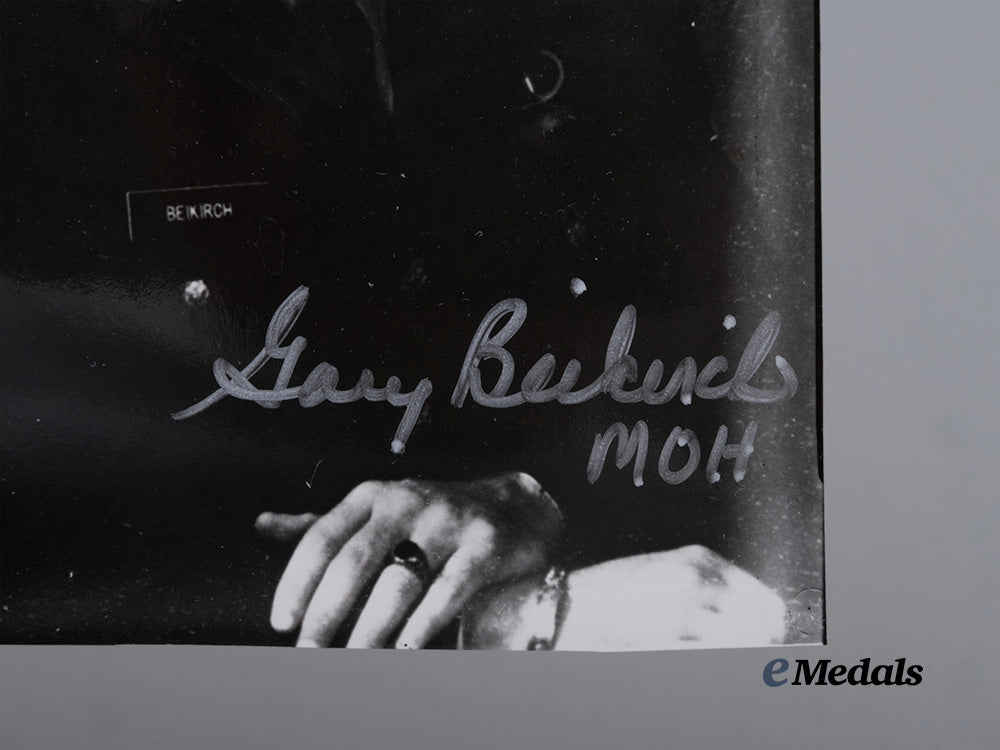
United States. A Signed Photograph of Congressional Medal of Honor Recipient, 1st Special Forces, USA
SKU: ITEM: W8675
Buyer's Premium
Current Bid:
Your Max Bid:
Bid History:
Time Remaining:
Couldn't load pickup availability
Shipping Details
Shipping Details
eMedals offers rapid domestic and international shipping. Orders received prior to 12:00pm (EST) will be shipped on the same business day.* Orders placed on Canadian Federal holidays will be dispatched the subsequent business day. Courier tracking numbers are provided for all shipments. All items purchased from eMedals can be returned for a full monetary refund or merchandise credit, providing the criteria presented in our Terms & Conditions are met. *Please note that the addition of a COA may impact dispatch time.
Shipping Details
eMedals offers rapid domestic and international shipping. Orders received prior to 12:00pm (EST) will be shipped on the same business day.* Orders placed on Canadian Federal holidays will be dispatched the subsequent business day. Courier tracking numbers are provided for all shipments. All items purchased from eMedals can be returned for a full monetary refund or merchandise credit, providing the criteria presented in our Terms & Conditions are met. *Please note that the addition of a COA may impact dispatch time.
Description
Description
In black and white, gloss finish, mass reproduction-style photograph, signed "Gary Beikirch MOH" in silver-colored ink at the lower right, measuring 95 mm (w) x 122 mm (h), extremely fine. Accompanied by a copy of his citation, signed in black ink "Gary Beikirch", along with a typewritten letter addressed to "Joe" (Searles) and signed in black ink "Gary".
Footnote: Gary Burnell Beikirch was born on August 29, 1947 in Rochester, New York and made his home in Buffalo, New York. He joined the United States Army in August 1967, just after finishing his second year of college in upstate New York. He was interested in becoming a Green Beret from the very beginning. He completed basic training at Fort Dix, New Jersey, and then went on to Fort Benning, Georgia, for jump school. He completed jump school, passed the Special Forces test and went on to training at Fort Bragg, North Carolina. After finishing phase one special forces training, he completed training to become a combat medic. During his time in the Army, Beikirch served with the 3rd, 5th and 10th Special Forces Groups as a Light Weapons and Medical Specialist. He was sent to Vietnam in July 1969. While serving in the rank of Sergeant with Company B of the 5th Special Forces Group, 1st Special Forces, Beikirch was stationed at Dak Seang Camp, home to Montagnard villagers and fighters, in the Central Highlands province of Kon Tum. On April 1, 1970, the camp was attacked by a numerically superior North Vietnamese force. While his Montagnard assistants treated the wounded, Beikirch fought back with a 4.2 inch mortar and, after that weapon was disabled by hostile fire, a machine gun. Learning that a fellow American soldier was wounded and lying in an exposed position, he ran through heavy fire to rescue the man. He was hit by shrapnel in the process, including one fragment which struck near his spine and partially paralyzed him. For the remainder of the battle he had his Montagnard assistants carry him from one position to another as he treated the injured. He was wounded in the side while giving mouth-to-mouth resuscitation to a Montagnard fighter and was then shot in the stomach. Despite this, he continued to provide medical care and fire his weapon from his stretcher until losing consciousness. He was evacuated by helicopter and spent six months recovering at Valley Forge Medical Center. For his actions at Dak Seang, Sergeant Beikirch was awarded the Congressional Medal of Honor by the Department of the Army, General Orders No. 37 (November 5, 1973). The medal was formally presented to him by President Richard Nixon on October 15, 1973. His citation states: "The President of the United States of America, in the name of Congress, takes pleasure in presenting the Medal of Honor to Sergeant Gary Burnell Beikirch, United States Army, for conspicuous gallantry and intrepidity at the risk of his life above and beyond the call of duty while serving with Detachment 8245, 5th Special Forces Group (Airborne), 1st Special Forces, in action against enemy aggressor forces at Dak Seang, Republic of Vietnam, on 1 April 1970. Sergeant Beikirch, Medical Aidman, Detachment B-24, Company B, distinguished himself during the defense of Camp Dak Seang. The allied defenders suffered a number of casualties as a result of an intense, devastating attack launched by the enemy from well-concealed positions surrounding the camp. Sergeant Beikirch, with complete disregard for his personal safety, moved unhesitatingly through the withering enemy fire to his fallen comrades, applied first aid to their wounds and assisted them to the medical aid station. When informed that a seriously injured American officer was lying in an exposed position, Sergeant Beikirch ran immediately through the hail of fire. Although he was wounded seriously by fragments from an exploding enemy mortar shell, Sergeant Beikirch carried the officer to a medical aid station. Ignoring his own serious injuries, Sergeant Beikirch left the relative safety of the medical bunker to search for and evacuate other men who had been injured. He was again wounded as he dragged a critically injured Vietnamese soldier to the medical bunker while simultaneously applying mouth-to-mouth resuscitation to sustain his life. Sergeant Beikirch again refused treatment and continued his search for other casualties until he collapsed. Only then did he permit himself to be treated. Sergeant Beikirch's complete devotion to the welfare of his comrades, at the risk of his life are in keeping with the highest traditions of the military service and reflect great credit on him, his unit, and the United States Army." In the letter that accompanies this photo and citation, he states that his experience taught him many life changing lessons: "how precious life is; how frightening death is; and how important God is to both life and death" and goes on to state that "After my time in Vietnam, being wounded three times, and spending almost a year in the hospital I was left with questions that I could not answer, an anger that I could not control, and a guilt that almost destroyed me. Two years later a friend of mine shared with me a simple but powerful message: God loved me, He had forgiven me because His son, Jesus Christ, died for me, and He wanted his spirit to become the center of my life". In addition to the Congressional Medal of Honor, he was awarded the Distinguished Service Cross, the Silver Star Medal, the Bronze Star Medal, the Purple Heart Medal with Oak Leaf Cluster, and the Vietnamese Cross of Gallantry with Silver Star. After his military service, Beikirch attended White Mountain Seminary in New Hampshire, graduating in 1975. He planned to go back to Vietnam and work in a missionary hospital in Kon Tum Province, where he had served in the Army, however, the country fell to North Vietnamese forces before he could return. He instead worked as a pastor and received a master's degree in counseling. Since the mid-1980s he has worked as a guidance counselor at Greece Arcadia Middle School in his native Rochester, New York. On September 22, 2012, the Second Battalion of the Fifth Special Forces Group (Airborne) dedicated a new battalion operations complex. The complex, formerly called "The Legion", was named Beikirch Hall in tribute to the former member of the unit.
Description
In black and white, gloss finish, mass reproduction-style photograph, signed "Gary Beikirch MOH" in silver-colored ink at the lower right, measuring 95 mm (w) x 122 mm (h), extremely fine. Accompanied by a copy of his citation, signed in black ink "Gary Beikirch", along with a typewritten letter addressed to "Joe" (Searles) and signed in black ink "Gary".
Footnote: Gary Burnell Beikirch was born on August 29, 1947 in Rochester, New York and made his home in Buffalo, New York. He joined the United States Army in August 1967, just after finishing his second year of college in upstate New York. He was interested in becoming a Green Beret from the very beginning. He completed basic training at Fort Dix, New Jersey, and then went on to Fort Benning, Georgia, for jump school. He completed jump school, passed the Special Forces test and went on to training at Fort Bragg, North Carolina. After finishing phase one special forces training, he completed training to become a combat medic. During his time in the Army, Beikirch served with the 3rd, 5th and 10th Special Forces Groups as a Light Weapons and Medical Specialist. He was sent to Vietnam in July 1969. While serving in the rank of Sergeant with Company B of the 5th Special Forces Group, 1st Special Forces, Beikirch was stationed at Dak Seang Camp, home to Montagnard villagers and fighters, in the Central Highlands province of Kon Tum. On April 1, 1970, the camp was attacked by a numerically superior North Vietnamese force. While his Montagnard assistants treated the wounded, Beikirch fought back with a 4.2 inch mortar and, after that weapon was disabled by hostile fire, a machine gun. Learning that a fellow American soldier was wounded and lying in an exposed position, he ran through heavy fire to rescue the man. He was hit by shrapnel in the process, including one fragment which struck near his spine and partially paralyzed him. For the remainder of the battle he had his Montagnard assistants carry him from one position to another as he treated the injured. He was wounded in the side while giving mouth-to-mouth resuscitation to a Montagnard fighter and was then shot in the stomach. Despite this, he continued to provide medical care and fire his weapon from his stretcher until losing consciousness. He was evacuated by helicopter and spent six months recovering at Valley Forge Medical Center. For his actions at Dak Seang, Sergeant Beikirch was awarded the Congressional Medal of Honor by the Department of the Army, General Orders No. 37 (November 5, 1973). The medal was formally presented to him by President Richard Nixon on October 15, 1973. His citation states: "The President of the United States of America, in the name of Congress, takes pleasure in presenting the Medal of Honor to Sergeant Gary Burnell Beikirch, United States Army, for conspicuous gallantry and intrepidity at the risk of his life above and beyond the call of duty while serving with Detachment 8245, 5th Special Forces Group (Airborne), 1st Special Forces, in action against enemy aggressor forces at Dak Seang, Republic of Vietnam, on 1 April 1970. Sergeant Beikirch, Medical Aidman, Detachment B-24, Company B, distinguished himself during the defense of Camp Dak Seang. The allied defenders suffered a number of casualties as a result of an intense, devastating attack launched by the enemy from well-concealed positions surrounding the camp. Sergeant Beikirch, with complete disregard for his personal safety, moved unhesitatingly through the withering enemy fire to his fallen comrades, applied first aid to their wounds and assisted them to the medical aid station. When informed that a seriously injured American officer was lying in an exposed position, Sergeant Beikirch ran immediately through the hail of fire. Although he was wounded seriously by fragments from an exploding enemy mortar shell, Sergeant Beikirch carried the officer to a medical aid station. Ignoring his own serious injuries, Sergeant Beikirch left the relative safety of the medical bunker to search for and evacuate other men who had been injured. He was again wounded as he dragged a critically injured Vietnamese soldier to the medical bunker while simultaneously applying mouth-to-mouth resuscitation to sustain his life. Sergeant Beikirch again refused treatment and continued his search for other casualties until he collapsed. Only then did he permit himself to be treated. Sergeant Beikirch's complete devotion to the welfare of his comrades, at the risk of his life are in keeping with the highest traditions of the military service and reflect great credit on him, his unit, and the United States Army." In the letter that accompanies this photo and citation, he states that his experience taught him many life changing lessons: "how precious life is; how frightening death is; and how important God is to both life and death" and goes on to state that "After my time in Vietnam, being wounded three times, and spending almost a year in the hospital I was left with questions that I could not answer, an anger that I could not control, and a guilt that almost destroyed me. Two years later a friend of mine shared with me a simple but powerful message: God loved me, He had forgiven me because His son, Jesus Christ, died for me, and He wanted his spirit to become the center of my life". In addition to the Congressional Medal of Honor, he was awarded the Distinguished Service Cross, the Silver Star Medal, the Bronze Star Medal, the Purple Heart Medal with Oak Leaf Cluster, and the Vietnamese Cross of Gallantry with Silver Star. After his military service, Beikirch attended White Mountain Seminary in New Hampshire, graduating in 1975. He planned to go back to Vietnam and work in a missionary hospital in Kon Tum Province, where he had served in the Army, however, the country fell to North Vietnamese forces before he could return. He instead worked as a pastor and received a master's degree in counseling. Since the mid-1980s he has worked as a guidance counselor at Greece Arcadia Middle School in his native Rochester, New York. On September 22, 2012, the Second Battalion of the Fifth Special Forces Group (Airborne) dedicated a new battalion operations complex. The complex, formerly called "The Legion", was named Beikirch Hall in tribute to the former member of the unit.

You May Also Like
Germany, Luftwaffe. A Pair of Eagle Insignia for Enlisted and Officer Ranks
G62855
United Kingdom. A Second Place Rifle Target Practice Medal, to Sergeant John McIntyre, 1861
M0625-118
United States. Two Second War Medal Bars to Joseph Edwin Twiss, US Navy
M0625-146
Czechoslovakia, Republic. A Lot of Five Medals
M0625-145
Spain, Fascist State. An Order of Agricultural Merit and Civil War Medal
M0625-119
-
Germany, Luftwaffe. A Pair of Eagle Insignia for Enlisted and Officer Ranks
G62855
Add to CartRegular price $108 USDRegular price $0 USD Sale price $108 USDUnit price / per -
United Kingdom. A Second Place Rifle Target Practice Medal, to Sergeant John McIntyre, 1861
M0625-118
Add to CartRegular price $200 USDRegular price $0 USD Sale price $200 USDUnit price / per -
United States. Two Second War Medal Bars to Joseph Edwin Twiss, US Navy
M0625-146
Add to CartRegular price $200 USDRegular price $0 USD Sale price $200 USDUnit price / per -
Czechoslovakia, Republic. A Lot of Five Medals
M0625-145
Add to CartRegular price $200 USDRegular price $0 USD Sale price $200 USDUnit price / per -
Spain, Fascist State. An Order of Agricultural Merit and Civil War Medal
M0625-119
Add to CartRegular price $135 USDRegular price $0 USD Sale price $135 USDUnit price / per
Do you have a similar item you are interested in selling?
Please complete the form and our client care representatives will contact you.
Sell Item