LOADING ...
In response to evolving domestic opinion, eMedals Inc has made the conscious decision to remove the presentation of German Third Reich historical artifacts from our online catalogue. For three decades, eMedals Inc has made an effort to preserve history in all its forms. As historians and researchers, we have managed sensitive articles and materials with the greatest of care and respect for their past and present social context. We acknowledge the growing sentiments put forth by the Canadian public and have taken proactive actions to address this opinion.
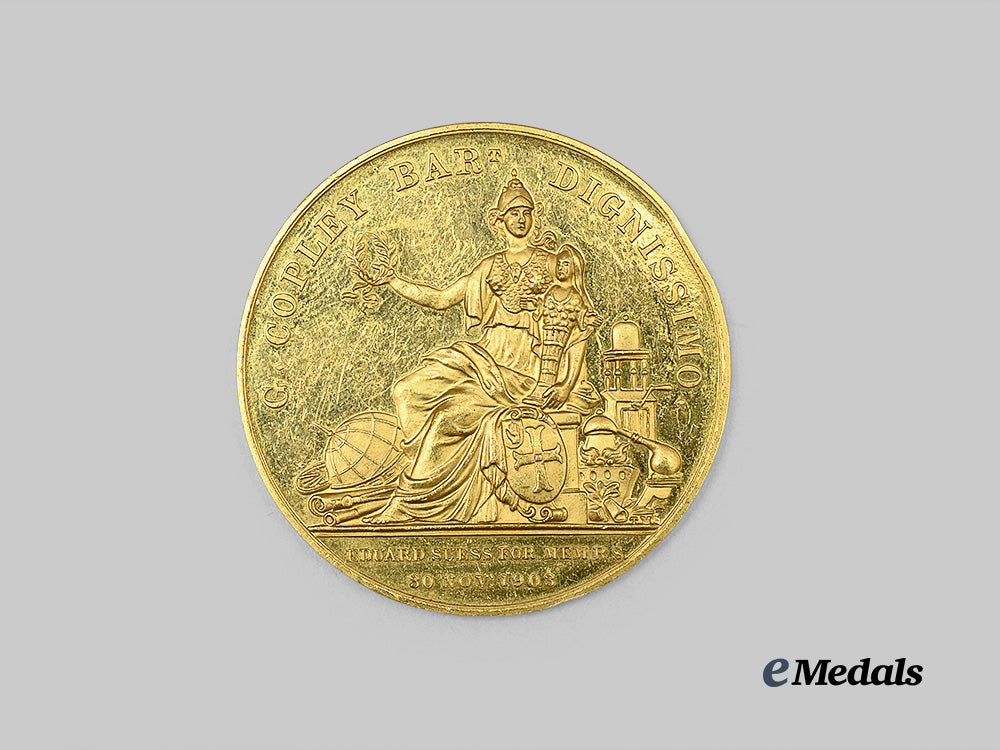
United Kingdom. An Exceptionally Rare Copley Medal in Gold to Eduard Suess, the “Dean of Geology”
SKU: ITEM: GB8780
Buyer's Premium
Current Bid:
Your Max Bid:
Bid History:
Time Remaining:
Couldn't load pickup availability
Shipping Details
Shipping Details
eMedals offers rapid domestic and international shipping. Orders received prior to 12:00pm (EST) will be shipped on the same business day.* Orders placed on Canadian Federal holidays will be dispatched the subsequent business day. Courier tracking numbers are provided for all shipments. All items purchased from eMedals can be returned for a full monetary refund or merchandise credit, providing the criteria presented in our Terms & Conditions are met. *Please note that the addition of a COA may impact dispatch time.
Description
Description
A historically-significant Copley Medal, constructed of 22K Gold, the obverse bearing a raised and exceptionally detailed depiction of Pallas, seated among items of science and learning, circumscribed by a raised inscription of “G. COPLEY BART. DIGNISSIMO”, situated above a raised recipient dedication of “EDUARD SUESS. FOR MEM. R.S. / 30. NOV: 1903”, the reverse bearing a raised coat of arms of the Royal Society, circumscribed by an inscription of “SOCIETAS REG: LONDINI”, situated above a banner bearing an inscription of “NULLIUS IN VERBA”, both the obverse and reverse engraver marked for Thomas Moring, measuring 43.11 mm in diameter, weighing 31.7 grams, demonstrating an edge bruise to the two o’clock position (as viewed from the obverse), an exceptionally rare example of a prestigious distinction awarded to a noted geologist, in extremely fine condition.
Footnote: Eduard Suess was born in London, England, on 20 August 1831 to a Saxon father, Adolph Heinrich Suess, and Austrian mother, Eleonore Friedrike Zdekauer. At the age of three, he relocated with his parents to the continent, first to Prague and later to Vienna, where the family managed a leather goods business and cared for an ailing relative. From a young age, Suess demonstrated academic gifts, becoming fluent in English, French, and German, while cultivating an interest in geology. He studied at the Clementinum and Akademisches Gymnasium before going to the Vienna Polytechnic Institute in 1846. During the Revolutions of 1848, he joined the Academic Legion and stood guard in front of a bank.
During a later visit to a museum in Prague, Sues observed Paleozoic fossils collected from the region, before an unspecific liver illness compelled him to seek spa treatment in Karlsbad, where he examined the local geology and published a booklet in 1851, at the age of just 18. Following publication, he established contacts with geologists and curators to further his studies and career, with the brief interruption of one month of imprisonment owing to his participation in the failed 1848 Revolution. This led to extensive field work and the publication of numerous papers on geology.
In 1855, Suess married Hermine Strauss, the niece of Moritz Hörnes, who was the director of the Hofmineralienkabinett. He applied for the position of a Privatdozent at the University of Vienna, but was rejected for having neither a doctorate nor a university degree. A frustrated Suess wrote a letter appealing to Count Leo of Thun and Hohenstein, who confirmed the rejection, but offered the alternative of an unsalaried professorship of paleontology at the same institute. Suess accepted the position in 1856, before transitioning to a professor of geology in 1861. In this capacity, he developed a number of theories, including a belief that Europe and Africa were once connected, with the Alps formerly at the bottom of an ocean, of which the present-day Mediterranean is a remnant of. A flawed theory, Suess bases his work on the principle of contractionism, in which the earth is cooling and consequently contracting. Nevertheless, he contributed valuable work to other studies of former land bridges and supercontinents throughout the 1880s and 1890s.
Among Suess' most notable works was Das Antlitz der Erde (The Face of the Earth), a comprehensive multi-volume publication setting out his key ideas between 1885 and 1901. Suess believed that the rise and fall of oceans (transgression and regression) was mappable across time. Citing fossil evidence, he postulated that Africa, India, and South America were once connected in a supercontinent called Gondwanaland, with the space formerly bridging the three now covered by oceans. He further theorized that the earth was subject to 25,900-year climate cycles driven by altered orbits around the sun and changing solar radiation.
Outside of his career as a geologist, Suess was also a member of the Austrian Parliament, holding his seat for 30 years, and devoted much time to investigating the economic implications of precious metals, and in particular whether the gold standard may not be suitable for all nations owing to geographic limitations. He ultimately advocated the stock of limited gold by world governments, but repudiated holding to a strict gold standard.
Suess has been cited as one of the earliest practitioners of ecology, and the legacy of his career is reflected in the naming of Suess Land in Greenland, the Suess crater on the moon, and an additional Suess crater on Mars. He was a member of the Royal Society, the National Academy of Sciences, the American Philosophical Society, and the Royal Swedish Academy of Sciences. Among his accolades was the Wollaston Medal of the Geographical Society of London (1896) and the accompanying Copley Medal of the Royal Society (1903). American paleontologist Charles Schuchert hailed him as the “dean of modern geology and geologists”. Suess died on 26 April 1914 in Vienna.

You May Also Like
Belgium, Kingdom. A M1889 Mauser Bayonet Letter Opener
EU25392
Croatia, Independent State. A Rare Narodna Zaštita Personnel Helmet, Repurposed Luftschutz Example
EU25504
France, Kingdom. A King Louis XVIII Commemorative Medal for the Founding of the Asiatic Society 1822
EU25347
Spain, Kingdom. A Gift to Eduardo Sáenz de Buruaga, from the Crew of the Personal Yacht of General Francisco Franco
EU25322
Netherlands, Kingdom. An Order of Orange-Nassau, Grand Cross Set, by s’Rijks Munt
EU25331
-
Belgium, Kingdom. A M1889 Mauser Bayonet Letter Opener
EU25392
Add to CartRegular price $135 USDRegular price $0 USD Sale price $135 USDUnit price / per -
Croatia, Independent State. A Rare Narodna Zaštita Personnel Helmet, Repurposed Luftschutz Example
EU25504
Add to CartRegular price $1,350 USDRegular price $0 USD Sale price $1,350 USDUnit price / per -
France, Kingdom. A King Louis XVIII Commemorative Medal for the Founding of the Asiatic Society 1822
EU25347
Add to CartRegular price $135 USDRegular price $0 USD Sale price $135 USDUnit price / per -
Spain, Kingdom. A Gift to Eduardo Sáenz de Buruaga, from the Crew of the Personal Yacht of General Francisco Franco
EU25322
Add to CartRegular price $1,350 USDRegular price $0 USD Sale price $1,350 USDUnit price / per -
Netherlands, Kingdom. An Order of Orange-Nassau, Grand Cross Set, by s’Rijks Munt
EU25331
Add to CartRegular price $2,225 USDRegular price $0 USD Sale price $2,225 USDUnit price / per
Do you have a similar item you are interested in selling?
Please complete the form and our client care representatives will contact you.
Sell Item