LOADING ...
In response to evolving domestic opinion, eMedals Inc has made the conscious decision to remove the presentation of German Third Reich historical artifacts from our online catalogue. For three decades, eMedals Inc has made an effort to preserve history in all its forms. As historians and researchers, we have managed sensitive articles and materials with the greatest of care and respect for their past and present social context. We acknowledge the growing sentiments put forth by the Canadian public and have taken proactive actions to address this opinion.
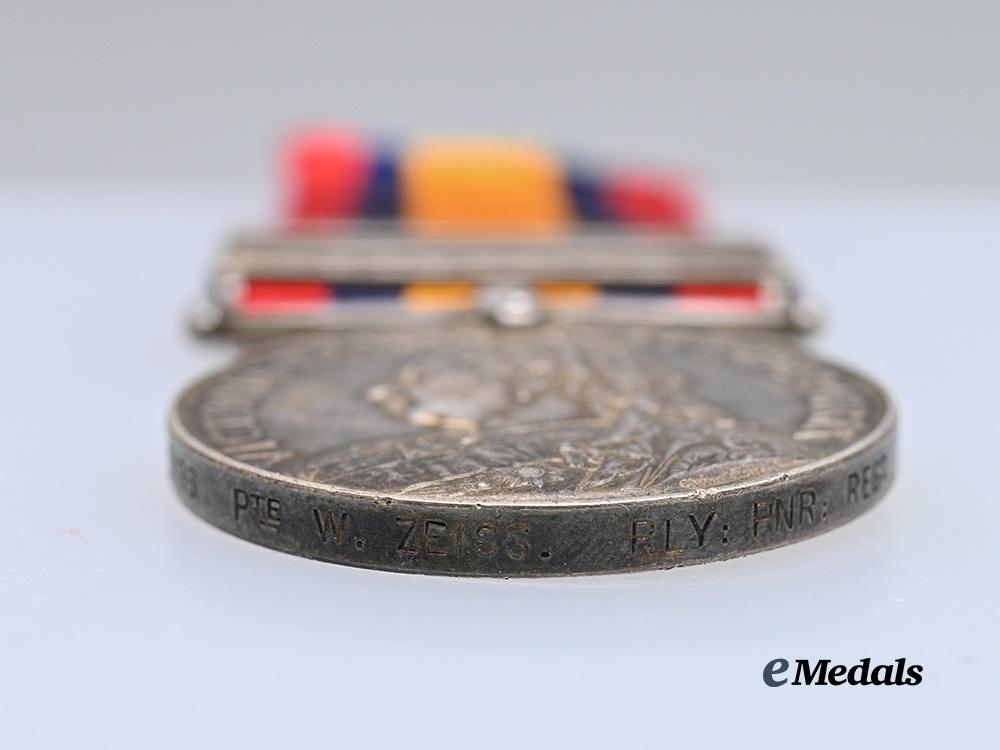
United Kingdom. A Queen’s South Africa Medal to Pte. William Zeiss, Railway Pioneer Regiment
SKU: ITEM: M0712-50
Buyer's Premium
Current Bid:
Your Max Bid:
Bid History:
Time Remaining:
Couldn't load pickup availability
Shipping Details
Shipping Details
eMedals offers rapid domestic and international shipping. Orders received prior to 12:00pm (EST) will be shipped on the same business day.* Orders placed on Canadian Federal holidays will be dispatched the subsequent business day. Courier tracking numbers are provided for all shipments. All items purchased from eMedals can be returned for a full monetary refund or merchandise credit, providing the criteria presented in our Terms & Conditions are met. *Please note that the addition of a COA may impact dispatch time.
Shipping Details
eMedals offers rapid domestic and international shipping. Orders received prior to 12:00pm (EST) will be shipped on the same business day.* Orders placed on Canadian Federal holidays will be dispatched the subsequent business day. Courier tracking numbers are provided for all shipments. All items purchased from eMedals can be returned for a full monetary refund or merchandise credit, providing the criteria presented in our Terms & Conditions are met. *Please note that the addition of a COA may impact dispatch time.
Description
Description
Instituted 1899. In silver, the rim officially impressed 2196 PTE W. ZEISS. RLY. PNR. REGT with TRANSVAAL, SOUTH AFRICA 1901 and SOUTH AFRICA 1902 clasps, replacement ribbon, light wear and small contact marks, lovely patina, extremely fine.
Footnote: Private William Zeiss is on the Queen’s South Africa Medal Roll. He was German born, and worked as an editor. He enrolled with 4th Battalion, B Company on December 19, 1900, at Maritzburg. He was discharged at the age of 64, due to time expired.
The South African Railway Pioneer Regiment was a specialized colonial unit raised during the Second Boer War (1899–1902) to repair, protect, and operate the vital railway network upon which British military logistics depended. Composed largely of engineers, railway workers, and colonial volunteers, the regiment restored damaged lines and bridges while accompanying advancing forces, ensuring the continuous movement of troops, supplies, and artillery across the vast South African theatre. Their work was instrumental in sustaining British operations during both the conventional and guerrilla phases of the war.
John Stirling’s The Colonials in South Africa recalls:
“About 18th December 1899 recruiting for this corps was opened at Cape Town; and before Lord Roberts commenced his advance from Bloemfontein to Pretoria the first regiment was organised, its work being to assist in protecting the railways and to repair bridges, culverts, and lines when broken. Without outside assistance the corps of Royal Engineers could not have faced the enormous amount of work naturally falling to their department. From the Railway Pioneer Regiment they received very valuable help. On the other hand, the Railway Pioneers were leavened by officers and non – commissioned officers of the Royal Engineers, who are always so efficient that they can infect all those who serve with them with esprit de corps in a marvellously short space of time. Of such value was the work of the Railway Pioneer Regiment that before the close of the war a fourth battalion had been organised. The battalions were employed chiefly on the Cape-Pretoria railway, but they were also on the Krugersdorp line, and sometimes operated as a fighting force a considerable distance from railways. The regiment also did admirable service on the armoured trains which did so much to make railway traffic possible during the guerilla stages.
In his evidence before the War Commission, volume 1 page 445, Lord Roberts said: “An enormous amount of reconstruction was carried out by the Railway Pioneer Regiment and the Railway Companies Royal Engineers. The Pioneer Regiment consisted almost entirely of civilian refugees, mostly mechanics from Johannesburg, and it rendered excellent service. To its aid and that of the Royal Engineer officers and men we were indebted for the fact that the railways very seldom lost touch with the fighting portion of the army, and that we were able to seize Johannesburg and Pretoria, distant about 1000 miles from our base upon the coast, and 260 miles from Bloemfontein, our advanced depot, with such rapidity that the enemy were unable to concentrate their resources and offer a strongly organised resistance”.
Description
Instituted 1899. In silver, the rim officially impressed 2196 PTE W. ZEISS. RLY. PNR. REGT with TRANSVAAL, SOUTH AFRICA 1901 and SOUTH AFRICA 1902 clasps, replacement ribbon, light wear and small contact marks, lovely patina, extremely fine.
Footnote: Private William Zeiss is on the Queen’s South Africa Medal Roll. He was German born, and worked as an editor. He enrolled with 4th Battalion, B Company on December 19, 1900, at Maritzburg. He was discharged at the age of 64, due to time expired.
The South African Railway Pioneer Regiment was a specialized colonial unit raised during the Second Boer War (1899–1902) to repair, protect, and operate the vital railway network upon which British military logistics depended. Composed largely of engineers, railway workers, and colonial volunteers, the regiment restored damaged lines and bridges while accompanying advancing forces, ensuring the continuous movement of troops, supplies, and artillery across the vast South African theatre. Their work was instrumental in sustaining British operations during both the conventional and guerrilla phases of the war.
John Stirling’s The Colonials in South Africa recalls:
“About 18th December 1899 recruiting for this corps was opened at Cape Town; and before Lord Roberts commenced his advance from Bloemfontein to Pretoria the first regiment was organised, its work being to assist in protecting the railways and to repair bridges, culverts, and lines when broken. Without outside assistance the corps of Royal Engineers could not have faced the enormous amount of work naturally falling to their department. From the Railway Pioneer Regiment they received very valuable help. On the other hand, the Railway Pioneers were leavened by officers and non – commissioned officers of the Royal Engineers, who are always so efficient that they can infect all those who serve with them with esprit de corps in a marvellously short space of time. Of such value was the work of the Railway Pioneer Regiment that before the close of the war a fourth battalion had been organised. The battalions were employed chiefly on the Cape-Pretoria railway, but they were also on the Krugersdorp line, and sometimes operated as a fighting force a considerable distance from railways. The regiment also did admirable service on the armoured trains which did so much to make railway traffic possible during the guerilla stages.
In his evidence before the War Commission, volume 1 page 445, Lord Roberts said: “An enormous amount of reconstruction was carried out by the Railway Pioneer Regiment and the Railway Companies Royal Engineers. The Pioneer Regiment consisted almost entirely of civilian refugees, mostly mechanics from Johannesburg, and it rendered excellent service. To its aid and that of the Royal Engineer officers and men we were indebted for the fact that the railways very seldom lost touch with the fighting portion of the army, and that we were able to seize Johannesburg and Pretoria, distant about 1000 miles from our base upon the coast, and 260 miles from Bloemfontein, our advanced depot, with such rapidity that the enemy were unable to concentrate their resources and offer a strongly organised resistance”.

You May Also Like
United Kingdom. The Handley Page Halifax, by K. A. Merrick, Signed
GB8679
United Kingdom. The Boer War Casualty Roll 1899-1902, Alexander M. Palmer
GB8680
Italy, Kingdom. An Order of the Crown, Knight in Gold
M0205-64
Finland, Republic. An Order of the Lion, Cross of Merit in Case
M0205-63
Belgium, Kingdom. An Order of the Crown and an Order of Leopold II, Two Knights
M0205-62
-
United Kingdom. The Handley Page Halifax, by K. A. Merrick, Signed
GB8679
Add to CartRegular price $200 USDRegular price $0 USD Sale price $200 USDUnit price / per -
United Kingdom. The Boer War Casualty Roll 1899-1902, Alexander M. Palmer
GB8680
Add to CartRegular price $75 USDRegular price $0 USD Sale price $75 USDUnit price / per -
Italy, Kingdom. An Order of the Crown, Knight in Gold
M0205-64
Add to CartRegular price $200 USDRegular price $0 USD Sale price $200 USDUnit price / per -
Finland, Republic. An Order of the Lion, Cross of Merit in Case
M0205-63
Add to CartRegular price $125 USDRegular price $0 USD Sale price $125 USDUnit price / per -
Belgium, Kingdom. An Order of the Crown and an Order of Leopold II, Two Knights
M0205-62
Add to CartRegular price $170 USDRegular price $0 USD Sale price $170 USDUnit price / per
Do you have a similar item you are interested in selling?
Please complete the form and our client care representatives will contact you.
Sell Item