LOADING ...
In response to evolving domestic opinion, eMedals Inc has made the conscious decision to remove the presentation of German Third Reich historical artifacts from our online catalogue. For three decades, eMedals Inc has made an effort to preserve history in all its forms. As historians and researchers, we have managed sensitive articles and materials with the greatest of care and respect for their past and present social context. We acknowledge the growing sentiments put forth by the Canadian public and have taken proactive actions to address this opinion.
Spain, Fascist State. A National Research Council Award With Case
SKU: ITEM: EU12433
Current Bid:
Your Max Bid:
Bid History:
Time Remaining:
Couldn't load pickup availability
Shipping Details
Shipping Details
eMedals offers rapid domestic and international shipping. Orders received prior to 12:00pm (EST) will be shipped on the same business day.* Orders placed on Canadian Federal holidays will be dispatched the subsequent business day. Courier tracking numbers are provided for all shipments. All items purchased from eMedals can be returned for a full monetary refund or merchandise credit, providing the criteria presented in our Terms & Conditions are met. *Please note that the addition of a COA may impact dispatch time.
Shipping Details
eMedals offers rapid domestic and international shipping. Orders received prior to 12:00pm (EST) will be shipped on the same business day.* Orders placed on Canadian Federal holidays will be dispatched the subsequent business day. Courier tracking numbers are provided for all shipments. All items purchased from eMedals can be returned for a full monetary refund or merchandise credit, providing the criteria presented in our Terms & Conditions are met. *Please note that the addition of a COA may impact dispatch time.
Description
Description
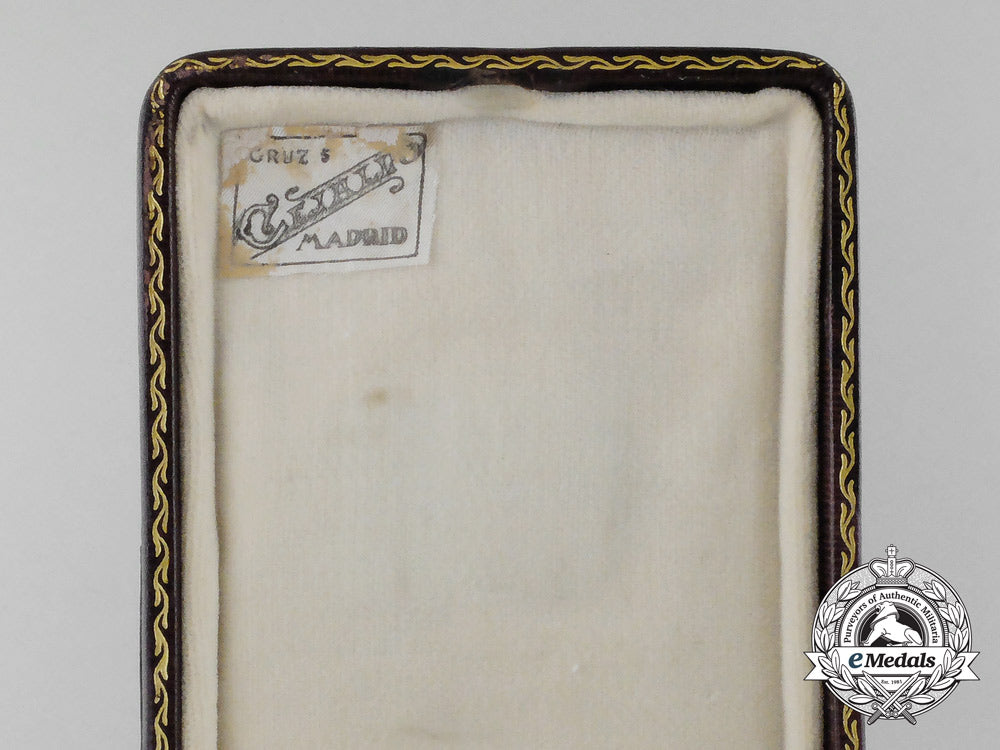
Two-piece construction, silver gilt with red, green, brown and white enamels, handpainted centrepiece, weighing 72 grams, obverse illustrating a shield bearing a tree with a flowing ribbon banner in white, the ribbon banner inscribed in black with various branches and divisions of the scientific community, the shield framed by a ribbon banner inscribed "CONSEJO SUPERIOR DE INVESTIGACIONES CIENTÍFICAS" (Spanish National Research Council), all on an ornamental Baroque shield, reverse with the engraved initials "L I", marked with a five-pointed star inside an oval (indicating a minimum of .915 purity in the silver, the mark originating after 1934), maker marked "CEJALVO" (of Madrid) and assay marked "55" above "M" (Madrid) inside a hexagon, 55.5 mm x 84.5 mm inclusive if its Franco crown suspension, loop housing a full-length neck cord with slider, the cord in orange braided embroidery, loop and t-post closure, intact enamels, scattered gilt wear, extremely fine. In its hardshelled case of issue, maker's label inscribed "CEJALVO MADRID" affixed to the lining on the inside lid, lightly soiled recessed platform medal bed, push closure, wear evident in the fabric overlying the hinged area, scuffed exterior, case very fine.
Footnote: The Spanish National Research Council (Consejo Superior de Investigaciones Científicas = CSIC) is the largest public institution dedicated to research in Spain and the third largest in Europe. Its main objective is to develop and promote research that will help bring about scientific and technological progress, and it is prepared to collaborate with Spanish and foreign entities in order to achieve this aim. The CSIC plays an important role in scientific and technological policy, since it encompasses an area that takes in everything from basic research to the transfer of knowledge to the productive sector. Its research is driven by its centres and institutes, which are spread across all the autonomous regions. Six percent of all CSIC staff is dedicated to Research and Development in Spain, and they generate approximately twenty percent of all scientific production in the country. It also manages a range of important facilities; the most complete and extensive network of specialist libraries, and also has joint research units. The CSIC was created in 1939 by the recently victorious Francoist regime from the assets of the Board for Advanced Studies (Junta para la Ampliación de Estudios = JAE, 1907-1939), born within The Free Educational Institution (Institución Libre de Enseñanza) and inspired in the Krausist philosophy. The initial mandate of the CSIC was to restore the classical and christian unity of the sciences that was destroyed in the eighteenth century. From its 1939 foundation to his 1966 death, its head was José María Albareda, one of the first members of the Opus Dei and a close friend of its founder, Josemaría Escrivá. José María Albareda was ordained a priest in 1959, and at his death was succeeded as head of CSIC by Manuel Lora-Tamayo, then the Education minister of Franco.
Description
Two-piece construction, silver gilt with red, green, brown and white enamels, handpainted centrepiece, weighing 72 grams, obverse illustrating a shield bearing a tree with a flowing ribbon banner in white, the ribbon banner inscribed in black with various branches and divisions of the scientific community, the shield framed by a ribbon banner inscribed "CONSEJO SUPERIOR DE INVESTIGACIONES CIENTÍFICAS" (Spanish National Research Council), all on an ornamental Baroque shield, reverse with the engraved initials "L I", marked with a five-pointed star inside an oval (indicating a minimum of .915 purity in the silver, the mark originating after 1934), maker marked "CEJALVO" (of Madrid) and assay marked "55" above "M" (Madrid) inside a hexagon, 55.5 mm x 84.5 mm inclusive if its Franco crown suspension, loop housing a full-length neck cord with slider, the cord in orange braided embroidery, loop and t-post closure, intact enamels, scattered gilt wear, extremely fine. In its hardshelled case of issue, maker's label inscribed "CEJALVO MADRID" affixed to the lining on the inside lid, lightly soiled recessed platform medal bed, push closure, wear evident in the fabric overlying the hinged area, scuffed exterior, case very fine.
Footnote: The Spanish National Research Council (Consejo Superior de Investigaciones Científicas = CSIC) is the largest public institution dedicated to research in Spain and the third largest in Europe. Its main objective is to develop and promote research that will help bring about scientific and technological progress, and it is prepared to collaborate with Spanish and foreign entities in order to achieve this aim. The CSIC plays an important role in scientific and technological policy, since it encompasses an area that takes in everything from basic research to the transfer of knowledge to the productive sector. Its research is driven by its centres and institutes, which are spread across all the autonomous regions. Six percent of all CSIC staff is dedicated to Research and Development in Spain, and they generate approximately twenty percent of all scientific production in the country. It also manages a range of important facilities; the most complete and extensive network of specialist libraries, and also has joint research units. The CSIC was created in 1939 by the recently victorious Francoist regime from the assets of the Board for Advanced Studies (Junta para la Ampliación de Estudios = JAE, 1907-1939), born within The Free Educational Institution (Institución Libre de Enseñanza) and inspired in the Krausist philosophy. The initial mandate of the CSIC was to restore the classical and christian unity of the sciences that was destroyed in the eighteenth century. From its 1939 foundation to his 1966 death, its head was José María Albareda, one of the first members of the Opus Dei and a close friend of its founder, Josemaría Escrivá. José María Albareda was ordained a priest in 1959, and at his death was succeeded as head of CSIC by Manuel Lora-Tamayo, then the Education minister of Franco.

You May Also Like
Germany, Federal Republic. The Bundesmarine Uniform Of Kapitän Zur See Hans Jenisch, U-Boat Ace And Knight’s Cross Recipient
M0540-88
“Daggers of the SA-NSKK 1933-1942: A Collector’s Gallery”, by M G White-May
978-1-7637979-1-8
Germany, Imperial. A Medal Bar for a Distinguished Franco-Prussian War Combatant
G62580
Germany, Imperial. A Letter Opener, with Lion Head Signet Pommel, by Weyersberg, Kirschbaum & Cie.
G62556
Germany, Imperial. A Superb Pilot’s Badge and Iron Cross Presentation Set, with Customized Display Case
G62555
-
Germany, Federal Republic. The Bundesmarine Uniform Of Kapitän Zur See Hans Jenisch, U-Boat Ace And Knight’s Cross Recipient
M0540-88
Add to CartRegular price $945 USDRegular price $0 USD Sale price $945 USDUnit price / per -
“Daggers of the SA-NSKK 1933-1942: A Collector’s Gallery”, by M G White-May
978-1-7637979-1-8
Add to CartRegular price $140 USDRegular price $0 USD Sale price $140 USDUnit price / per -
Germany, Imperial. A Medal Bar for a Distinguished Franco-Prussian War Combatant
G62580
Add to CartRegular price $405 USDRegular price $0 USD Sale price $405 USDUnit price / per -
Germany, Imperial. A Letter Opener, with Lion Head Signet Pommel, by Weyersberg, Kirschbaum & Cie.
G62556
Add to CartRegular price $270 USDRegular price $0 USD Sale price $270 USDUnit price / per -
Germany, Imperial. A Superb Pilot’s Badge and Iron Cross Presentation Set, with Customized Display Case
G62555
Add to CartRegular price $2,025 USDRegular price $0 USD Sale price $2,025 USDUnit price / per
Do you have a similar item you are interested in selling?
Please complete the form and our client care representatives will contact you.
Sell Item