LOADING ...
In response to evolving domestic opinion, eMedals Inc has made the conscious decision to remove the presentation of German Third Reich historical artifacts from our online catalogue. For three decades, eMedals Inc has made an effort to preserve history in all its forms. As historians and researchers, we have managed sensitive articles and materials with the greatest of care and respect for their past and present social context. We acknowledge the growing sentiments put forth by the Canadian public and have taken proactive actions to address this opinion.
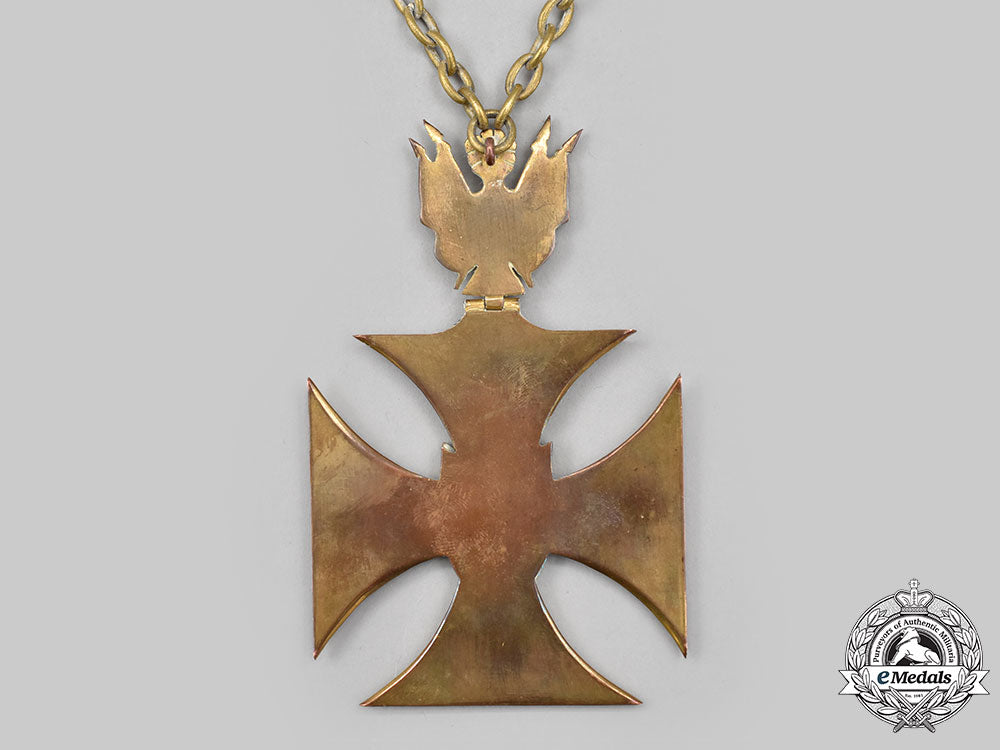
International. A Royal Sovereign Military Order Of Our Lady Of Mercy, Neck Badge
SKU: ITEM: EU20220
Current Bid:
Your Max Bid:
Bid History:
Time Remaining:
Couldn't load pickup availability
Shipping Details
Shipping Details
eMedals offers rapid domestic and international shipping. Orders received prior to 12:00pm (EST) will be shipped on the same business day.* Orders placed on Canadian Federal holidays will be dispatched the subsequent business day. Courier tracking numbers are provided for all shipments. All items purchased from eMedals can be returned for a full monetary refund or merchandise credit, providing the criteria presented in our Terms & Conditions are met. *Please note that the addition of a COA may impact dispatch time.
Shipping Details
eMedals offers rapid domestic and international shipping. Orders received prior to 12:00pm (EST) will be shipped on the same business day.* Orders placed on Canadian Federal holidays will be dispatched the subsequent business day. Courier tracking numbers are provided for all shipments. All items purchased from eMedals can be returned for a full monetary refund or merchandise credit, providing the criteria presented in our Terms & Conditions are met. *Please note that the addition of a COA may impact dispatch time.
Description
Description
(Ordre Royal Souverain Militaire de Notre-Damede la Merci). Instituted in 1218. Two-piece construction, insignia in bronze gilt with red enamels, mounted to a cross base in bronze gilt with white enamels, with a trophy-of-arms hinged to the top edge, unmarked, measuring 59.5 mm (w) x 94.2 mm (h) inclusive of its trophy-of-arms suspension, on a full-length neck chain in bronze gilt, intact enamels, residue evident in the recessed areas on the crown, the trophy-of-arms suspension and the chain from cleaning, near extremely fine.
Footnote: The Royal, Celestial and Military Order of Our Lady of Mercy and the Redemption of the Captives, also known as the Mercedarians, is a Catholic mendicant order established in 1218 by St. Peter Nolasco in the city of Barcelona, at that time in the Principality of Catalonia (Crown of Aragon), for the redemption of Christian captives. Its members are most commonly known as Mercedarian friars or nuns. One of the distinguishing marks of the Order of the Blessed Virgin Mary of Mercy is that, since its foundation, its members are required to take a fourth vow to, if necessary, to die for another who is in danger of losing their faith. At first, the Order of Mercy had, at the same time, religious and military characteristics and that the first Masters General were lay knights. With the passing of time, the knightly and military aspects lost the importance that they had, especially in the first century of the Order. However, in the course of history and particularly in Spain, there were investitures and groups of lay knights, never contested by the Holy See or any civil or ecclesiastical authority. In 1926, the Order’s Master General, Juan del Carmelo Garrido, reformed the Statutes of the association and established new norms for secular knights whom he divided into five classes or ranks: Great Cross, Commander with badge and title, Honorary Commander, Knights and Donates, setting up emblems for each category, uniforms, honors and precedence. Two years later, the King of Spain, Alfonso XIII, Great Commander of Our Lady of Mercy, issued a decree placing the Order of Mercy on the same level as other Spanish Orders of Knights and authorizing the use of badges and titles. According to the Knights’ Statutes, their main objective was the profession and practice of the Catholic faith, practicing Christian virtues, charitable works for missions and anti-slavery propaganda. In his 1931 report to the General Chapter, the Master General confirmed that, at that time, there were 300 knights. Later on, in 1936, due to complaints from other military orders whose emblems were eclipsed by the beauty, historical and heraldic transcendence of the Mercedarians’, though it recognized in practice the Order’s right to confer these emblems, the Holy See asked the Order to refrain from conferring them. Although the King of Spain offered to intervene, in obedience to the Church’s voice, the Order never granted them again. On the same occasion, Pope Pius XI removed from the Mercedarian title the appellatives of Royal and Military which the Order had since its origin. The Order exists today in seventeen countries.
Description
(Ordre Royal Souverain Militaire de Notre-Damede la Merci). Instituted in 1218. Two-piece construction, insignia in bronze gilt with red enamels, mounted to a cross base in bronze gilt with white enamels, with a trophy-of-arms hinged to the top edge, unmarked, measuring 59.5 mm (w) x 94.2 mm (h) inclusive of its trophy-of-arms suspension, on a full-length neck chain in bronze gilt, intact enamels, residue evident in the recessed areas on the crown, the trophy-of-arms suspension and the chain from cleaning, near extremely fine.
Footnote: The Royal, Celestial and Military Order of Our Lady of Mercy and the Redemption of the Captives, also known as the Mercedarians, is a Catholic mendicant order established in 1218 by St. Peter Nolasco in the city of Barcelona, at that time in the Principality of Catalonia (Crown of Aragon), for the redemption of Christian captives. Its members are most commonly known as Mercedarian friars or nuns. One of the distinguishing marks of the Order of the Blessed Virgin Mary of Mercy is that, since its foundation, its members are required to take a fourth vow to, if necessary, to die for another who is in danger of losing their faith. At first, the Order of Mercy had, at the same time, religious and military characteristics and that the first Masters General were lay knights. With the passing of time, the knightly and military aspects lost the importance that they had, especially in the first century of the Order. However, in the course of history and particularly in Spain, there were investitures and groups of lay knights, never contested by the Holy See or any civil or ecclesiastical authority. In 1926, the Order’s Master General, Juan del Carmelo Garrido, reformed the Statutes of the association and established new norms for secular knights whom he divided into five classes or ranks: Great Cross, Commander with badge and title, Honorary Commander, Knights and Donates, setting up emblems for each category, uniforms, honors and precedence. Two years later, the King of Spain, Alfonso XIII, Great Commander of Our Lady of Mercy, issued a decree placing the Order of Mercy on the same level as other Spanish Orders of Knights and authorizing the use of badges and titles. According to the Knights’ Statutes, their main objective was the profession and practice of the Catholic faith, practicing Christian virtues, charitable works for missions and anti-slavery propaganda. In his 1931 report to the General Chapter, the Master General confirmed that, at that time, there were 300 knights. Later on, in 1936, due to complaints from other military orders whose emblems were eclipsed by the beauty, historical and heraldic transcendence of the Mercedarians’, though it recognized in practice the Order’s right to confer these emblems, the Holy See asked the Order to refrain from conferring them. Although the King of Spain offered to intervene, in obedience to the Church’s voice, the Order never granted them again. On the same occasion, Pope Pius XI removed from the Mercedarian title the appellatives of Royal and Military which the Order had since its origin. The Order exists today in seventeen countries.

You May Also Like
United Kingdom. The Handley Page Halifax, by K. A. Merrick, Signed
GB8679
United Kingdom. The Boer War Casualty Roll 1899-1902, Alexander M. Palmer
GB8680
Germany, Heer. A Lot of Award Documents to Wilhelm Duschl, Battle of Crete Combatant
G62942
United States. Two Second War Medal Bars to Joseph Edwin Twiss, US Navy
M0625-146
Czechoslovakia, Republic. A Lot of Five Medals
M0625-145
-
United Kingdom. The Handley Page Halifax, by K. A. Merrick, Signed
GB8679
Add to CartRegular price $200 USDRegular price $0 USD Sale price $200 USDUnit price / per -
United Kingdom. The Boer War Casualty Roll 1899-1902, Alexander M. Palmer
GB8680
Add to CartRegular price $75 USDRegular price $0 USD Sale price $75 USDUnit price / per -
Germany, Heer. A Lot of Award Documents to Wilhelm Duschl, Battle of Crete Combatant
G62942
Add to CartRegular price $810 USDRegular price $0 USD Sale price $810 USDUnit price / per -
United States. Two Second War Medal Bars to Joseph Edwin Twiss, US Navy
M0625-146
Add to CartRegular price $200 USDRegular price $0 USD Sale price $200 USDUnit price / per -
Czechoslovakia, Republic. A Lot of Five Medals
M0625-145
Add to CartRegular price $200 USDRegular price $0 USD Sale price $200 USDUnit price / per
Do you have a similar item you are interested in selling?
Please complete the form and our client care representatives will contact you.
Sell Item