LOADING ...
In response to evolving domestic opinion, eMedals Inc has made the conscious decision to remove the presentation of German Third Reich historical artifacts from our online catalogue. For three decades, eMedals Inc has made an effort to preserve history in all its forms. As historians and researchers, we have managed sensitive articles and materials with the greatest of care and respect for their past and present social context. We acknowledge the growing sentiments put forth by the Canadian public and have taken proactive actions to address this opinion.
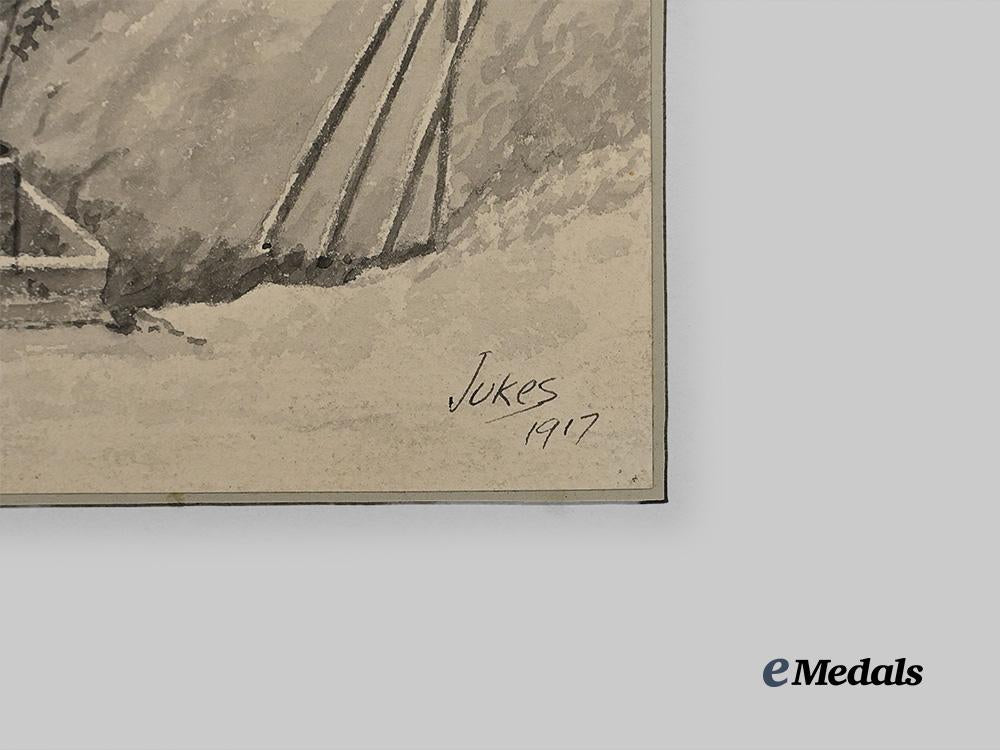
Canada, CEF. “Captured German Dug-Out on Vimy Ridge”, Ink on Paper, by Pte. Jukes, 1917
SKU: ITEM: M0687-95
Buyer's Premium
Current Bid:
Your Max Bid:
Bid History:
Time Remaining:
Couldn't load pickup availability
Shipping Details
Shipping Details
eMedals offers rapid domestic and international shipping. Orders received prior to 12:00pm (EST) will be shipped on the same business day.* Orders placed on Canadian Federal holidays will be dispatched the subsequent business day. Courier tracking numbers are provided for all shipments. All items purchased from eMedals can be returned for a full monetary refund or merchandise credit, providing the criteria presented in our Terms & Conditions are met. *Please note that the addition of a COA may impact dispatch time.
Shipping Details
eMedals offers rapid domestic and international shipping. Orders received prior to 12:00pm (EST) will be shipped on the same business day.* Orders placed on Canadian Federal holidays will be dispatched the subsequent business day. Courier tracking numbers are provided for all shipments. All items purchased from eMedals can be returned for a full monetary refund or merchandise credit, providing the criteria presented in our Terms & Conditions are met. *Please note that the addition of a COA may impact dispatch time.
Description
Description
Black ink on paper entitled “Captured German Dug-Out on Vimy Ridge” in blue ink, the image featuring a ‘cut-and cover dugout’ (excavated space which was covered with logs, iron, sandbags and topped with earth), signed “Jukes 1917” in the bottom right corner, mounted to a board offering a matte frame, measures 302 mm (w) x 236 mm (h), minor wear to board, remains extremely fine.
Footnote: Reuben Jukes (Jucksch) was a Canadian soldier and artist who served in the First War, and is known for his unique watercolours, presenting soldiers, buildings, and sights from the first hand experience of an individual at war and on the front lines.
Jukes was born July 5, 1887 in Hanover, Ontario. Prior to enlisting at the age of 27, he listed his trade as an artist. He joined the 20th Battalion in Toronto on November 10, 1914, with previous service experience in the 31st Regiment.
He was hospitalized in March 1916 for shell shock and was not discharged until October 16, 1916. He was struck off strength to the 5th Reserve Battalion at Bramshott on January 31, 1917. He returned to the 20th battalion, and active service in May 1917.
While serving with the 20th battalion overseas, relieving the 20th battalion, he was wounded by shell gas. He was admitted to the No. 56 General Hospital at Etapes on April 25, 1918. The records state he “vomits occasionally, particularly on bending, some headache, stitch in R. breast, some loss of appetite and weakness.” He was evacuated to England and remained hospitalized until July 26th.
Jukes returned to the 20th battalion in October, 1918, at Thun-Levesque. When the war ended on November 11th, he was in Saint-Symphorien. The advance from La Bouverie resulted in the loss of 1 officer, 11 other ranks killed and 30 wounded. About 10 soldiers were taken prisoner, just before the cease-fire.
The battalion rested in Mons, France for roughly a week following the Armistice. They then continued the March to the Rhine.
Jukes was demobilized in May 1919, ultimately returning to Canada. After the war, he worked in Vaudeville both as a set painter and in various acts. In 1924, he married Amelia Louisa Hagen. In 1940, he opened his own business painting signs in Kitchener, Ontario. Jukes died in May 1959, at the age of 71, in Kitchener.
His watercolours have been exhibited in multiple museums and offer a unique first hand account of the front lines, and life as a soldier during the Great War.
Description
Black ink on paper entitled “Captured German Dug-Out on Vimy Ridge” in blue ink, the image featuring a ‘cut-and cover dugout’ (excavated space which was covered with logs, iron, sandbags and topped with earth), signed “Jukes 1917” in the bottom right corner, mounted to a board offering a matte frame, measures 302 mm (w) x 236 mm (h), minor wear to board, remains extremely fine.
Footnote: Reuben Jukes (Jucksch) was a Canadian soldier and artist who served in the First War, and is known for his unique watercolours, presenting soldiers, buildings, and sights from the first hand experience of an individual at war and on the front lines.
Jukes was born July 5, 1887 in Hanover, Ontario. Prior to enlisting at the age of 27, he listed his trade as an artist. He joined the 20th Battalion in Toronto on November 10, 1914, with previous service experience in the 31st Regiment.
He was hospitalized in March 1916 for shell shock and was not discharged until October 16, 1916. He was struck off strength to the 5th Reserve Battalion at Bramshott on January 31, 1917. He returned to the 20th battalion, and active service in May 1917.
While serving with the 20th battalion overseas, relieving the 20th battalion, he was wounded by shell gas. He was admitted to the No. 56 General Hospital at Etapes on April 25, 1918. The records state he “vomits occasionally, particularly on bending, some headache, stitch in R. breast, some loss of appetite and weakness.” He was evacuated to England and remained hospitalized until July 26th.
Jukes returned to the 20th battalion in October, 1918, at Thun-Levesque. When the war ended on November 11th, he was in Saint-Symphorien. The advance from La Bouverie resulted in the loss of 1 officer, 11 other ranks killed and 30 wounded. About 10 soldiers were taken prisoner, just before the cease-fire.
The battalion rested in Mons, France for roughly a week following the Armistice. They then continued the March to the Rhine.
Jukes was demobilized in May 1919, ultimately returning to Canada. After the war, he worked in Vaudeville both as a set painter and in various acts. In 1924, he married Amelia Louisa Hagen. In 1940, he opened his own business painting signs in Kitchener, Ontario. Jukes died in May 1959, at the age of 71, in Kitchener.
His watercolours have been exhibited in multiple museums and offer a unique first hand account of the front lines, and life as a soldier during the Great War.

You May Also Like
Germany, Kriegsmarine. A Foul Weather Rain Cap, by Willy Sprengpfeil
G61154
Germany, Imperial. A Mixed Lot of Merit Medals
G61095
Germany, Luftwaffe. A Technical Flight School Sleeve Insignia
G45598
Germany, Weimar Republic. A North Rhine-Westphalia Police Belt Buckle
G45525
Germany, Third Reich. A Mixed Lot of Sleeve Chevrons
G61067
-
Germany, Kriegsmarine. A Foul Weather Rain Cap, by Willy Sprengpfeil
G61154
Add to CartRegular price $338 USDRegular price $0 USD Sale price $338 USDUnit price / per -
Germany, Imperial. A Mixed Lot of Merit Medals
G61095
Add to CartRegular price $135 USDRegular price $0 USD Sale price $135 USDUnit price / per -
Germany, Luftwaffe. A Technical Flight School Sleeve Insignia
G45598
Add to CartRegular price $70 USDRegular price $0 USD Sale price $70 USDUnit price / per -
Germany, Weimar Republic. A North Rhine-Westphalia Police Belt Buckle
G45525
Add to CartRegular price $80 USDRegular price $0 USD Sale price $80 USDUnit price / per -
Germany, Third Reich. A Mixed Lot of Sleeve Chevrons
G61067
Add to CartRegular price $108 USDRegular price $0 USD Sale price $108 USDUnit price / per
Do you have a similar item you are interested in selling?
Please complete the form and our client care representatives will contact you.
Sell Item