LOADING ...
In response to evolving domestic opinion, eMedals Inc has made the conscious decision to remove the presentation of German Third Reich historical artifacts from our online catalogue. For three decades, eMedals Inc has made an effort to preserve history in all its forms. As historians and researchers, we have managed sensitive articles and materials with the greatest of care and respect for their past and present social context. We acknowledge the growing sentiments put forth by the Canadian public and have taken proactive actions to address this opinion.
Canada. A Military Medal To Acting Battery Sergeant Major Edward Goss, Bravery In The Field, Cfa
SKU: ITEM: C5657
Current Bid:
Your Max Bid:
Bid History:
Time Remaining:
Couldn't load pickup availability
Shipping Details
Shipping Details
eMedals offers rapid domestic and international shipping. Orders received prior to 12:00pm (EST) will be shipped on the same business day.* Orders placed on Canadian Federal holidays will be dispatched the subsequent business day. Courier tracking numbers are provided for all shipments. All items purchased from eMedals can be returned for a full monetary refund or merchandise credit, providing the criteria presented in our Terms & Conditions are met. *Please note that the addition of a COA may impact dispatch time.
Shipping Details
eMedals offers rapid domestic and international shipping. Orders received prior to 12:00pm (EST) will be shipped on the same business day.* Orders placed on Canadian Federal holidays will be dispatched the subsequent business day. Courier tracking numbers are provided for all shipments. All items purchased from eMedals can be returned for a full monetary refund or merchandise credit, providing the criteria presented in our Terms & Conditions are met. *Please note that the addition of a COA may impact dispatch time.
Description
Description
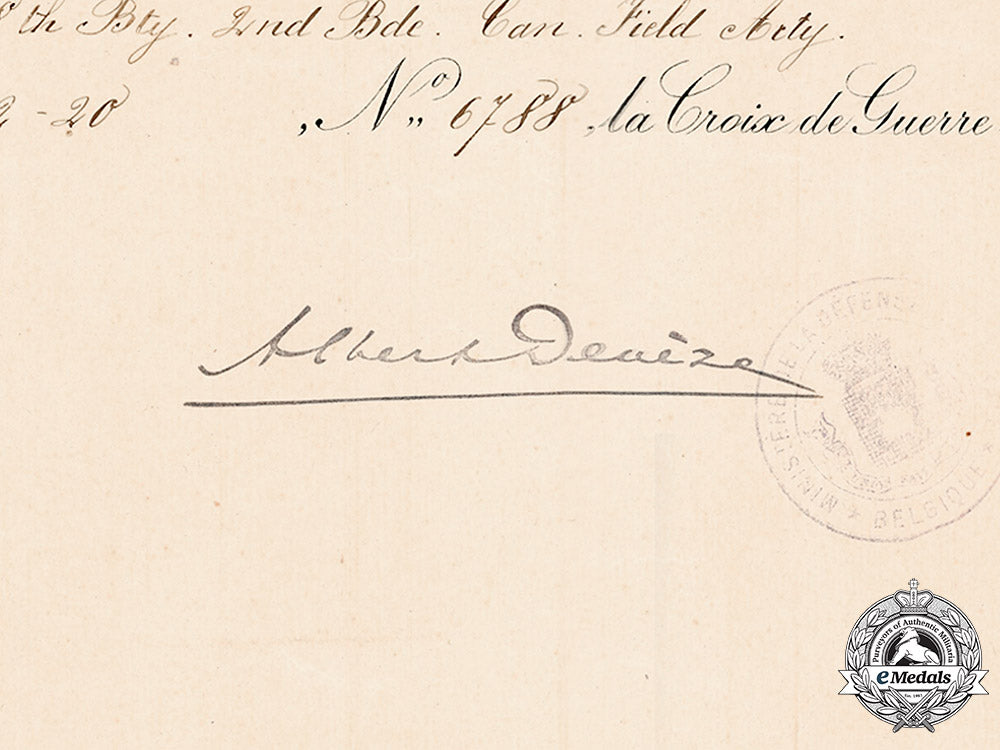
Military Medal, George V (300579 SJT: E. GOSS. CAN: F.A.); 1914-15 Star (300579 GNR: E. GOSS. 1/CAN: DIV: A.C.); British War Medal (300579 A. B. S. MJR. E. GOSS. C.F.A.); Victory Medal (300579 A. B. S. MJR. E. GOSS. C.F.A.); and Belgium: Croix de Guerre. Naming is officially impressed on the four British medals, the CdeG is un-named as issued. Mounted to a suspension with swing bar pinback, as worn by the veteran, dark patina on the two silver medals, edge nicks on the MM, BWM and VM, the Star with residue in the recessed areas from cleaning, spotting on the VM, light contact, original ribbons, very fine. Accompanied by an original Croix de Guerre Award Certificate (inscribed in French "Royaume de Belgique / Le Ministre de la Défense Nationale / A l'honneur de faire savoir au Sergt. Edward Goss, No. 300579, 48th Bty. 2nd Bde. Can. Field Arty. que, par Arrète Royal du 27-2-20, No. 6788, la Croid de Guerre lui a été décernié." (English: Kingdom of Belgium / The Minister of National Defense / has the honor to inform Sergeant Edward Goss, No. 300579, 48th Battery, 2nd Brigade, Canadian Field Artillery that, by Royal Decree of February 27, 1920, No. 6788, the Croix de Guerre was awarded to him), printed in black ink on an off-white paper stock, measuring 490 mm (w) x 410 mm (h), edge wear and tears, lightly soiled; in its O.H.M.S. transmittal tube, addressed to "Ed. Goss Esq., / 91 Soudan Ave., Toronto, Ont."), along with copies of his Index Cards, Attestation Paper, Service Records, Medical Records, Pay Records, Discharge Certificates, 2nd Brigade Canadian Field Artillery War Diary of August 18, 1917 (the day Sergeant Goss was gassed) and London Gazette Announcements (confirming his award of the Military Medal and the Croix de Guerre).
Footnote: Edward Goss was born on June 1, 1891 in Toronto, Ontario. He signed his Attestation Paper as a Private (300579) with the 34th Battery, Canadian Field Artillery, on August 16, 1915 in Toronto, at the age of 24, naming his next-of-kin as his father, Henry Goss of Toronto, stating that he had no previous military service, that he was not married, that his religion was Church of England and that his trade as that of Blaster, which was later changed to Mail Sorter. Upon arrival in England, he was transferred as a Gunner to the 3rd Battery, Canadian Field Artillery on October 25, 1915. Eight weeks later, he was transferred to the 1st Divisional Ammunition Column for service in the French theatre on December 21, 1915, arriving in France on the 23rd. Eleven days after arriving in France, Private Goss was transferred to the 2nd Brigade, Canadian Field Artillery on January 3, 1916, arriving with them in the field on the 6th. Later that Summer, he was "absent from 4:40 a.m. muster parade and 6:30 a.m. parade" on August 19, 1916 and was subsequently sentenced to three days' Field Punishment No. 1 on August 25th. Field Punishment No. 1 consisted of the convicted man being placed in fetters and handcuffs or similar restraints and attached to a fixed object, such as a gun wheel or a fence post, for up to two hours per day. During the early part of the First World War, the punishment was often applied with the arms stretched out and the legs tied together, giving rise to the nickname "crucifixion". He again ran afoul of the authorities three months later, as he was sentenced to fourteen days' Field Punishment No. 1 "for while on active service", he was "drunk" on November 21, 1916. Private Goss was admitted to hospital on December 9, 1916, the reason for his admission "not stated" and after four days, he rejoined his unit on the 13th. He was promoted to Acting Bombardier on March 21, 1917, then promoted to Bombardier on August 9, 1917. Private Goss was in action with the 2nd Brigade, Canadian Field Artillery, when he was "wounded mild" from a gas attack on August 18, 1917. The attack on his unit is described in the 2nd Brigade Canadian Field Artillery War Diary of August 18, 1917: "At 1:55 a.m. we received an S.O.S. from Capt. Harding, to which we responded promptly. Cease fire came in at 2:29 a.m. At 2:35 a.m., the enemy started to drench our positions with gas shells. At 4:22 a.m., we received an S.O.S. from Capt. Harding. Cease fire came in at 5:35 a.m., rest of (the) day passed quietly". He required treatment for his gas poisoning, first at No. 58 Casualty Clearing Station the same day, followed by his admission to No. 56 General Hospital at Etaples on August 20th. After four days' treatment at Etaples, he was discharged on the 24th and rejoined his unit on September 6th, having made a "Good Recovery". Private Goss was promoted to the rank of Corporal on January 25, 1918, then promoted to the rank of Sergeant on April 23, 1918. He was appointed Acting Battery Quartermaster Sergeant on February 8, 1919 and confirmed in the rank on the 14th. Goss was appointed Battery Sergeant Major on March 15th and proceeded to England on March 22nd.
In his Medical History of an Invalid, dated March 27, 1919 at Bramshott, the attending physician noted that Goss had a "slight deafness in his right ear" due to "tubal catarrhal" (an inflammation of the mucous membranes in one of the airways or cavities of the body, usually with reference to the throat and paranasal sinuses). The causes of this condition were traced back to January 1917 while he was serving in France, the doctor noting that Goss' "deafness (was) better or worse, according to changes in (the) weather" but it was "much better now that (he was) not exposed to gunfire". It was determined that he did not require treatment, the doctor declaring him to be Category "A" (Fit for General Service). After his medical assessment, he was posted to "A" Wing at the Canadian Corps Camp on March 31st for return to Canada. He embarked Liverpool aboard the S.S. Baltic on April 29, 1919, arriving in Canada a week later. Acting Battery Sergeant Major Edward Goss, Canadian Field Artillery was discharged upon demobilization at No. 2 District Depot in Toronto, on May 9, 1919, credited with having served in Canada, England, France and Belgium, entitled to wear the War Service Badge, Class "A", number 284222. For his First World War service, he was awarded the British War Medal and the Victory Medal. Sergeant Goss was with the 2nd Brigade, Canadian Field Artillery when he was awarded the Belgian Croix de Guerre, for "distinguished services rendered during the course of the campaign", the announcement appearing in the Fourth Supplement to the London Gazette 31275 of Thursday, April 4, 1919, on Friday, April 5, 1919, page 4523. Sergeant Goss was with the 48th Howitzer Battery, 2nd Brigade, Canadian Field Artillery when he was awarded the Military Medal, "for bravery in the field", the announcement appearing in the Third Supplement to the London Gazette 31430 of Tuesday, July 1, 1919, on Thursday, July 3, 1919, page 8342. He died on June 28, 1952, at the age of 61.
Description
Military Medal, George V (300579 SJT: E. GOSS. CAN: F.A.); 1914-15 Star (300579 GNR: E. GOSS. 1/CAN: DIV: A.C.); British War Medal (300579 A. B. S. MJR. E. GOSS. C.F.A.); Victory Medal (300579 A. B. S. MJR. E. GOSS. C.F.A.); and Belgium: Croix de Guerre. Naming is officially impressed on the four British medals, the CdeG is un-named as issued. Mounted to a suspension with swing bar pinback, as worn by the veteran, dark patina on the two silver medals, edge nicks on the MM, BWM and VM, the Star with residue in the recessed areas from cleaning, spotting on the VM, light contact, original ribbons, very fine. Accompanied by an original Croix de Guerre Award Certificate (inscribed in French "Royaume de Belgique / Le Ministre de la Défense Nationale / A l'honneur de faire savoir au Sergt. Edward Goss, No. 300579, 48th Bty. 2nd Bde. Can. Field Arty. que, par Arrète Royal du 27-2-20, No. 6788, la Croid de Guerre lui a été décernié." (English: Kingdom of Belgium / The Minister of National Defense / has the honor to inform Sergeant Edward Goss, No. 300579, 48th Battery, 2nd Brigade, Canadian Field Artillery that, by Royal Decree of February 27, 1920, No. 6788, the Croix de Guerre was awarded to him), printed in black ink on an off-white paper stock, measuring 490 mm (w) x 410 mm (h), edge wear and tears, lightly soiled; in its O.H.M.S. transmittal tube, addressed to "Ed. Goss Esq., / 91 Soudan Ave., Toronto, Ont."), along with copies of his Index Cards, Attestation Paper, Service Records, Medical Records, Pay Records, Discharge Certificates, 2nd Brigade Canadian Field Artillery War Diary of August 18, 1917 (the day Sergeant Goss was gassed) and London Gazette Announcements (confirming his award of the Military Medal and the Croix de Guerre).
Footnote: Edward Goss was born on June 1, 1891 in Toronto, Ontario. He signed his Attestation Paper as a Private (300579) with the 34th Battery, Canadian Field Artillery, on August 16, 1915 in Toronto, at the age of 24, naming his next-of-kin as his father, Henry Goss of Toronto, stating that he had no previous military service, that he was not married, that his religion was Church of England and that his trade as that of Blaster, which was later changed to Mail Sorter. Upon arrival in England, he was transferred as a Gunner to the 3rd Battery, Canadian Field Artillery on October 25, 1915. Eight weeks later, he was transferred to the 1st Divisional Ammunition Column for service in the French theatre on December 21, 1915, arriving in France on the 23rd. Eleven days after arriving in France, Private Goss was transferred to the 2nd Brigade, Canadian Field Artillery on January 3, 1916, arriving with them in the field on the 6th. Later that Summer, he was "absent from 4:40 a.m. muster parade and 6:30 a.m. parade" on August 19, 1916 and was subsequently sentenced to three days' Field Punishment No. 1 on August 25th. Field Punishment No. 1 consisted of the convicted man being placed in fetters and handcuffs or similar restraints and attached to a fixed object, such as a gun wheel or a fence post, for up to two hours per day. During the early part of the First World War, the punishment was often applied with the arms stretched out and the legs tied together, giving rise to the nickname "crucifixion". He again ran afoul of the authorities three months later, as he was sentenced to fourteen days' Field Punishment No. 1 "for while on active service", he was "drunk" on November 21, 1916. Private Goss was admitted to hospital on December 9, 1916, the reason for his admission "not stated" and after four days, he rejoined his unit on the 13th. He was promoted to Acting Bombardier on March 21, 1917, then promoted to Bombardier on August 9, 1917. Private Goss was in action with the 2nd Brigade, Canadian Field Artillery, when he was "wounded mild" from a gas attack on August 18, 1917. The attack on his unit is described in the 2nd Brigade Canadian Field Artillery War Diary of August 18, 1917: "At 1:55 a.m. we received an S.O.S. from Capt. Harding, to which we responded promptly. Cease fire came in at 2:29 a.m. At 2:35 a.m., the enemy started to drench our positions with gas shells. At 4:22 a.m., we received an S.O.S. from Capt. Harding. Cease fire came in at 5:35 a.m., rest of (the) day passed quietly". He required treatment for his gas poisoning, first at No. 58 Casualty Clearing Station the same day, followed by his admission to No. 56 General Hospital at Etaples on August 20th. After four days' treatment at Etaples, he was discharged on the 24th and rejoined his unit on September 6th, having made a "Good Recovery". Private Goss was promoted to the rank of Corporal on January 25, 1918, then promoted to the rank of Sergeant on April 23, 1918. He was appointed Acting Battery Quartermaster Sergeant on February 8, 1919 and confirmed in the rank on the 14th. Goss was appointed Battery Sergeant Major on March 15th and proceeded to England on March 22nd.
In his Medical History of an Invalid, dated March 27, 1919 at Bramshott, the attending physician noted that Goss had a "slight deafness in his right ear" due to "tubal catarrhal" (an inflammation of the mucous membranes in one of the airways or cavities of the body, usually with reference to the throat and paranasal sinuses). The causes of this condition were traced back to January 1917 while he was serving in France, the doctor noting that Goss' "deafness (was) better or worse, according to changes in (the) weather" but it was "much better now that (he was) not exposed to gunfire". It was determined that he did not require treatment, the doctor declaring him to be Category "A" (Fit for General Service). After his medical assessment, he was posted to "A" Wing at the Canadian Corps Camp on March 31st for return to Canada. He embarked Liverpool aboard the S.S. Baltic on April 29, 1919, arriving in Canada a week later. Acting Battery Sergeant Major Edward Goss, Canadian Field Artillery was discharged upon demobilization at No. 2 District Depot in Toronto, on May 9, 1919, credited with having served in Canada, England, France and Belgium, entitled to wear the War Service Badge, Class "A", number 284222. For his First World War service, he was awarded the British War Medal and the Victory Medal. Sergeant Goss was with the 2nd Brigade, Canadian Field Artillery when he was awarded the Belgian Croix de Guerre, for "distinguished services rendered during the course of the campaign", the announcement appearing in the Fourth Supplement to the London Gazette 31275 of Thursday, April 4, 1919, on Friday, April 5, 1919, page 4523. Sergeant Goss was with the 48th Howitzer Battery, 2nd Brigade, Canadian Field Artillery when he was awarded the Military Medal, "for bravery in the field", the announcement appearing in the Third Supplement to the London Gazette 31430 of Tuesday, July 1, 1919, on Thursday, July 3, 1919, page 8342. He died on June 28, 1952, at the age of 61.

You May Also Like
Russia, Imperial. A Rare Order of Saint Stanislaus, I Class Cross Set, by Keibel
M0367-42
Germany, Heer. A Rare Großdeutschland Division Service Tunic for a Leutnant of Engineers, Late-War Example
G62717
Germany, Federal Republic. The Bundesmarine Uniform Of Kapitän Zur See Hans Jenisch, U-Boat Ace And Knight’s Cross Recipient
M0540-88
Germany, Heer. A 7. Gebirgs Division POW Trench Art Commemorative Campaign Plaque
M0320-10
Germany, Wehrmacht. An M30 Gas Mask, with Canister
G62679
-
Russia, Imperial. A Rare Order of Saint Stanislaus, I Class Cross Set, by Keibel
M0367-42
Add to CartRegular price $9,600 USDRegular price $0 USD Sale price $9,600 USDUnit price / per -
Germany, Heer. A Rare Großdeutschland Division Service Tunic for a Leutnant of Engineers, Late-War Example
G62717
Add to CartRegular price $3,375 USDRegular price $0 USD Sale price $3,375 USDUnit price / per -
Germany, Federal Republic. The Bundesmarine Uniform Of Kapitän Zur See Hans Jenisch, U-Boat Ace And Knight’s Cross Recipient
M0540-88
Add to CartRegular price $945 USDRegular price $0 USD Sale price $945 USDUnit price / per -
Germany, Heer. A 7. Gebirgs Division POW Trench Art Commemorative Campaign Plaque
M0320-10
Add to CartRegular price $108 USDRegular price $0 USD Sale price $108 USDUnit price / per -
Germany, Wehrmacht. An M30 Gas Mask, with Canister
G62679
Add to CartRegular price $340 USDRegular price $0 USD Sale price $340 USDUnit price / per
Do you have a similar item you are interested in selling?
Please complete the form and our client care representatives will contact you.
Sell Item