LOADING ...
In response to evolving domestic opinion, eMedals Inc has made the conscious decision to remove the presentation of German Third Reich historical artifacts from our online catalogue. For three decades, eMedals Inc has made an effort to preserve history in all its forms. As historians and researchers, we have managed sensitive articles and materials with the greatest of care and respect for their past and present social context. We acknowledge the growing sentiments put forth by the Canadian public and have taken proactive actions to address this opinion.
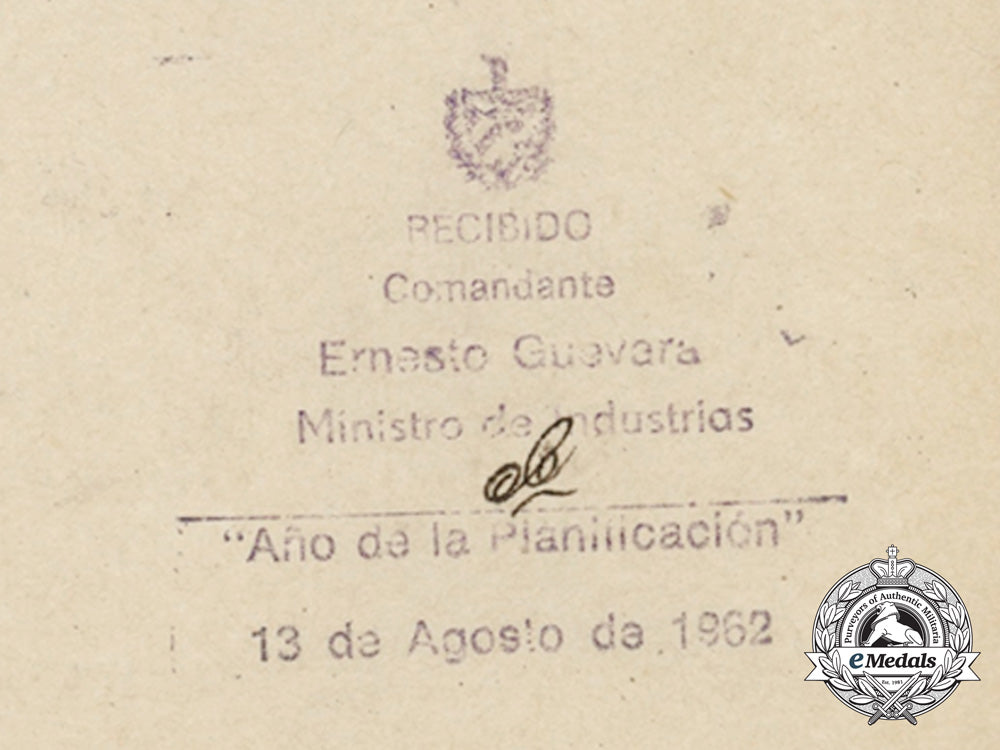
A 1962 Letter From Dr.armando Alvarez Azcue Signed By Commander Ernesto "Che" Guevara
SKU: ITEM: W4341
Current Bid:
Your Max Bid:
Bid History:
Time Remaining:
Couldn't load pickup availability
Shipping Details
Shipping Details
eMedals offers rapid domestic and international shipping. Orders received prior to 12:00pm (EST) will be shipped on the same business day.* Orders placed on Canadian Federal holidays will be dispatched the subsequent business day. Courier tracking numbers are provided for all shipments. All items purchased from eMedals can be returned for a full monetary refund or merchandise credit, providing the criteria presented in our Terms & Conditions are met. *Please note that the addition of a COA may impact dispatch time.
Description
Description
Printed in blue ink "Por acuerdo de este Ministerio de Mayo de 1961 se tomo razon al Folio 220 del Libro 65 del Registro de Marcas del Traspaso de esta modalidad a favor del Estado Cubano, por haber sido nacionalizada la entidad propietaria / La Habana, 1 de Agosto de 1961 "ANO DE LA EDUCACION", Vto. Bno." (By agreement of the Ministry of May 1961 Folio 220 reason to Book 65 of the Registration of Marks of Transfer of this type in favour of the Cuban State it was taken, having been nationalized the owning entity / Havana, August 1, 1961 "Year of Education" Vto. Bno.), with a handwritten message in black ink, two stamps in blue ink inscribed "Dr. Armando Alvarez Azcue / Jefe del Departamento de Traspasos" (Dr. Armando Alvarez Azcue / Head of the Department of Transfers), stamped in blue ink "ENVIAR AL, MINISTERO DE INDUSTRIAS" (Send to the Ministry of Industries), stamped in blue ink "RECIBIDO Comandante Ernesto Guevara Ministro de Industrias "Ano de la Planificacion" 13 de Agosto de 1962" (RECEIVED Commander Ernesto Guevara Minister of Industries "Year of Planning" August 13, 1962) and signed "Che" in black ink on the stamp, on an off-white paper stock, 200 mm x 295 mm, tattered edges on the left side, foxing, fine.
Footnote: Ernesto "Che" Guevara (June 14, 1928 - October 9, 1967), commonly known as El Che or simply Che, was an Argentine Marxist revolutionary, physician, author, guerrilla leader,diplomat, and military theorist. A major figure of the Cuban Revolution, his stylized visage has become a ubiquitous countercultural symbol of rebellion and global insignia in popular culture. As a young medical student, Guevara travelled throughout South America and was radicalized by the poverty, hunger, and disease he witnessed. His burgeoning desire to help overturn what he saw as the capitalist exploitation of Latin America by the United States prompted his involvement in Guatemala's social reforms under President Jacobo Árbenz, whose eventual CIA-assisted overthrow at the behest of the United Fruit Company solidified Guevara's political ideology. Later, in Mexico City, he met Raúl and Fidel Castro, joined their 26th of July Movement, and sailed to Cuba aboard the yacht Granma, with the intention of overthrowing U.S.-backed Cuban dictator Fulgencio Batista. Guevara soon rose to prominence among the insurgents, was promoted to second-in-command, and played a pivotal role in the victorious two-year guerrilla campaign that deposed the Batista regime. Following the Cuban Revolution, Guevara performed a number of key roles in the new government. These included reviewing the appeals and firing squads for those convicted as war criminals during the revolutionary tribunals, instituting agrarian land reform as minister of industries, helping spearhead a successful nationwide literacy campaign, serving as both national bank president and instructional director for Cuba's armed forces, and traversing the globe as a diplomat on behalf of Cuban socialism. Such positions also allowed him to play a central role in training the militia forces who repelled the Bay of Pigs Invasion and bringing the Soviet nuclear-armed ballistic missiles to Cuba, which precipitated the 1962 Cuban Missile Crisis. Additionally, he was a prolific writer and diarist, composing a seminal manual on guerrilla warfare, along with a best-selling memoir about his youthful continental motorcycle journey. His experiences and studying of Marxism-Leninism led him to posit that the Third World's underdevelopment and dependence was an intrinsic result of imperialism, neocolonialism, and monopoly capitalism, with the only remedy being proletarian internationalism and world revolution. Guevara left Cuba in 1965 to foment revolution abroad, first unsuccessfully in Congo-Kinshasa and later in Bolivia, where he was captured by CIA-assisted Bolivian forces and summarily executed.

You May Also Like
Serbia, Kingdom. An Order of St. Sava, III Class Commander
EU25484
Russia, Imperial. An Order of Saint Andrew, Center Medallion of the Star, in Gold , Silver and "Diamonds"
EU25479
Prussia, Kingdom. A Rare Order of St. John, Knight’s Cross, c. 1900
G64575
Germany, Third Reich. A Set of Land Customs Visor Cap Insignia for Enlisted Ranks
G64569
Germany, RLB. A Mint Visor Cap Insignia for Enlisted Ranks, Maker Marked Example
G64562
-
Serbia, Kingdom. An Order of St. Sava, III Class Commander
EU25484
Add to CartRegular price $475 USDRegular price $0 USD Sale price $475 USDUnit price / per -
Russia, Imperial. An Order of Saint Andrew, Center Medallion of the Star, in Gold , Silver and "Diamonds"
EU25479
Add to CartRegular price $14,500 USDRegular price $0 USD Sale price $14,500 USDUnit price / per -
Prussia, Kingdom. A Rare Order of St. John, Knight’s Cross, c. 1900
G64575
Add to CartRegular price $1,750 USDRegular price $0 USD Sale price $1,750 USDUnit price / per -
Germany, Third Reich. A Set of Land Customs Visor Cap Insignia for Enlisted Ranks
G64569
Add to CartRegular price $205 USDRegular price $0 USD Sale price $205 USDUnit price / per -
Germany, RLB. A Mint Visor Cap Insignia for Enlisted Ranks, Maker Marked Example
G64562
Add to CartRegular price $108 USDRegular price $0 USD Sale price $108 USDUnit price / per
Do you have a similar item you are interested in selling?
Please complete the form and our client care representatives will contact you.
Sell Item