LOADING ...
In response to evolving domestic opinion, eMedals Inc has made the conscious decision to remove the presentation of German Third Reich historical artifacts from our online catalogue. For three decades, eMedals Inc has made an effort to preserve history in all its forms. As historians and researchers, we have managed sensitive articles and materials with the greatest of care and respect for their past and present social context. We acknowledge the growing sentiments put forth by the Canadian public and have taken proactive actions to address this opinion.
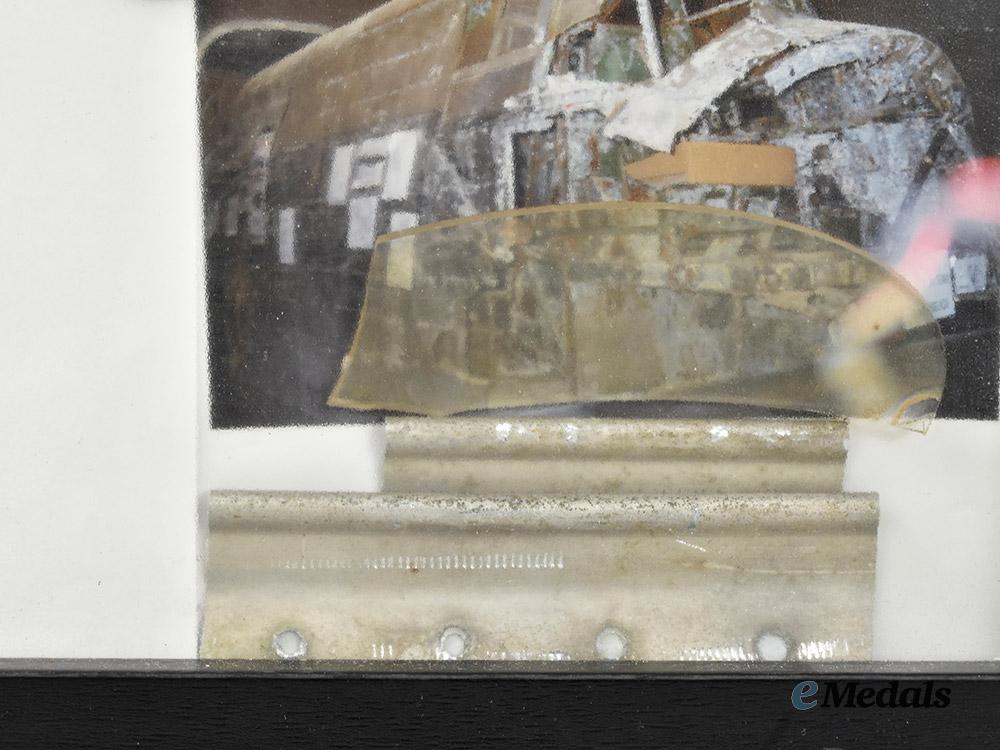
United Kingdom. Framed stringer and glass pieces of the Downed Halifax, April 1945
SKU: ITEM: M0631-26
Current Bid:
Your Max Bid:
Bid History:
Time Remaining:
Couldn't load pickup availability
Shipping Details
Shipping Details
eMedals offers rapid domestic and international shipping. Orders received prior to 12:00pm (EST) will be shipped on the same business day.* Orders placed on Canadian Federal holidays will be dispatched the subsequent business day. Courier tracking numbers are provided for all shipments. All items purchased from eMedals can be returned for a full monetary refund or merchandise credit, providing the criteria presented in our Terms & Conditions are met. *Please note that the addition of a COA may impact dispatch time.
Shipping Details
eMedals offers rapid domestic and international shipping. Orders received prior to 12:00pm (EST) will be shipped on the same business day.* Orders placed on Canadian Federal holidays will be dispatched the subsequent business day. Courier tracking numbers are provided for all shipments. All items purchased from eMedals can be returned for a full monetary refund or merchandise credit, providing the criteria presented in our Terms & Conditions are met. *Please note that the addition of a COA may impact dispatch time.
Description
Description
Two pieces of glass and two pieces of stringer (structural framework), contained in a glass frame with black wooden exterior. The interior shows a sheet below with reading: “The Halifax journey began when the almost new aircraft took off from Tarrant Ruston Air Base in Southern England, on the night of April 23,1945. Its mission - dropping supplies to Norwegian resistance fighters. The Halifax was returning home when it was hit by anti-aircraft fire over the town of Minnesund. A fuel tank caught fire. The pilot Alexan Thurbull decided to ditch his aircraft in Lake Mjoso. For decades, the downed Halifax a model Mark A VII Aircraft 7 No. NA337X lay undisturbed at the bottom of the lake, 750 feet deep and a mile from shore.” Accompanied by an embroidered RAF wing in black, white and red threads, measuring roughly 115 mm (w) x 45 mm (h), contained in the frame, very fine. Measures 386 mm (w) x 209 mm (h) x 20 mm (d), the reverse offers a wire hanger and is slightly bent to accommodate the glass and stringer pieces. Light wear, very fine overall.
Footnote: Handley Page Halifax NA337 (coded 2P-X) was a Mk VII heavy bomber built in early 1945 and assigned to No. 644 Squadron, Royal Air Force, based at RAF Tarrant Rushton in Dorset. The squadron specialized in supply drops and glider-towing operations in support of airborne and resistance forces. On 24 March 1945, during Operation Varsity—the large-scale Allied airborne crossing of the Rhine—NA337 took off towing a Horsa glider carrying troops and equipment for the 6th Airborne Division. After releasing the glider near the target zone, the Halifax was struck by German anti-aircraft fire over Norway while returning from a subsequent supply drop to resistance fighters. The crew attempted to nurse the damaged aircraft back to base but were forced to ditch in Lake Mjøsa near Harestua. Three crewmen were killed and four survived, captured by German forces. Ultimately only one of six crewmen survived the war.
The wreckage lay undisturbed at a depth of 750 feet until its discovery and recovery in 1995. Following an extensive ten-year restoration, NA337 was unveiled at the National Air Force Museum of Canada in Trenton, Ontario, in 2005, where it remains one of the only complete and original Halifax bombers in existence.
Description
Two pieces of glass and two pieces of stringer (structural framework), contained in a glass frame with black wooden exterior. The interior shows a sheet below with reading: “The Halifax journey began when the almost new aircraft took off from Tarrant Ruston Air Base in Southern England, on the night of April 23,1945. Its mission - dropping supplies to Norwegian resistance fighters. The Halifax was returning home when it was hit by anti-aircraft fire over the town of Minnesund. A fuel tank caught fire. The pilot Alexan Thurbull decided to ditch his aircraft in Lake Mjoso. For decades, the downed Halifax a model Mark A VII Aircraft 7 No. NA337X lay undisturbed at the bottom of the lake, 750 feet deep and a mile from shore.” Accompanied by an embroidered RAF wing in black, white and red threads, measuring roughly 115 mm (w) x 45 mm (h), contained in the frame, very fine. Measures 386 mm (w) x 209 mm (h) x 20 mm (d), the reverse offers a wire hanger and is slightly bent to accommodate the glass and stringer pieces. Light wear, very fine overall.
Footnote: Handley Page Halifax NA337 (coded 2P-X) was a Mk VII heavy bomber built in early 1945 and assigned to No. 644 Squadron, Royal Air Force, based at RAF Tarrant Rushton in Dorset. The squadron specialized in supply drops and glider-towing operations in support of airborne and resistance forces. On 24 March 1945, during Operation Varsity—the large-scale Allied airborne crossing of the Rhine—NA337 took off towing a Horsa glider carrying troops and equipment for the 6th Airborne Division. After releasing the glider near the target zone, the Halifax was struck by German anti-aircraft fire over Norway while returning from a subsequent supply drop to resistance fighters. The crew attempted to nurse the damaged aircraft back to base but were forced to ditch in Lake Mjøsa near Harestua. Three crewmen were killed and four survived, captured by German forces. Ultimately only one of six crewmen survived the war.
The wreckage lay undisturbed at a depth of 750 feet until its discovery and recovery in 1995. Following an extensive ten-year restoration, NA337 was unveiled at the National Air Force Museum of Canada in Trenton, Ontario, in 2005, where it remains one of the only complete and original Halifax bombers in existence.

You May Also Like
Prussia, Kingdom. An Order of the Crown, II Class Cross with Swords, c.1917
G62842
Germany, Imperial. An Infantry Oberleutnant Shoulder Board
G41459
Russia, Imperial. A Rare Order of Saint Stanislaus, I Class Cross Set, by Keibel
M0367-42
Germany, Imperial. A First World War Patriotic Paper Weight
G62761
Spain, Spanish State. An Order of Military Merit, IV Class Grand Cross Breast Star, German-Made Example for Condor Legion Personnel
EU24861
-
Prussia, Kingdom. An Order of the Crown, II Class Cross with Swords, c.1917
G62842
Add to CartRegular price $2,025 USDRegular price $0 USD Sale price $2,025 USDUnit price / per -
Germany, Imperial. An Infantry Oberleutnant Shoulder Board
G41459
Add to CartRegular price $60 USDRegular price $0 USD Sale price $60 USDUnit price / per -
Russia, Imperial. A Rare Order of Saint Stanislaus, I Class Cross Set, by Keibel
M0367-42
Add to CartRegular price $9,600 USDRegular price $0 USD Sale price $9,600 USDUnit price / per -
Germany, Imperial. A First World War Patriotic Paper Weight
G62761
Add to CartRegular price $108 USDRegular price $0 USD Sale price $108 USDUnit price / per -
Spain, Spanish State. An Order of Military Merit, IV Class Grand Cross Breast Star, German-Made Example for Condor Legion Personnel
EU24861
Add to CartRegular price $540 USDRegular price $0 USD Sale price $540 USDUnit price / per
Do you have a similar item you are interested in selling?
Please complete the form and our client care representatives will contact you.
Sell Item