LOADING ...
In response to evolving domestic opinion, eMedals Inc has made the conscious decision to remove the presentation of German Third Reich historical artifacts from our online catalogue. For three decades, eMedals Inc has made an effort to preserve history in all its forms. As historians and researchers, we have managed sensitive articles and materials with the greatest of care and respect for their past and present social context. We acknowledge the growing sentiments put forth by the Canadian public and have taken proactive actions to address this opinion.
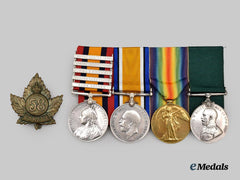
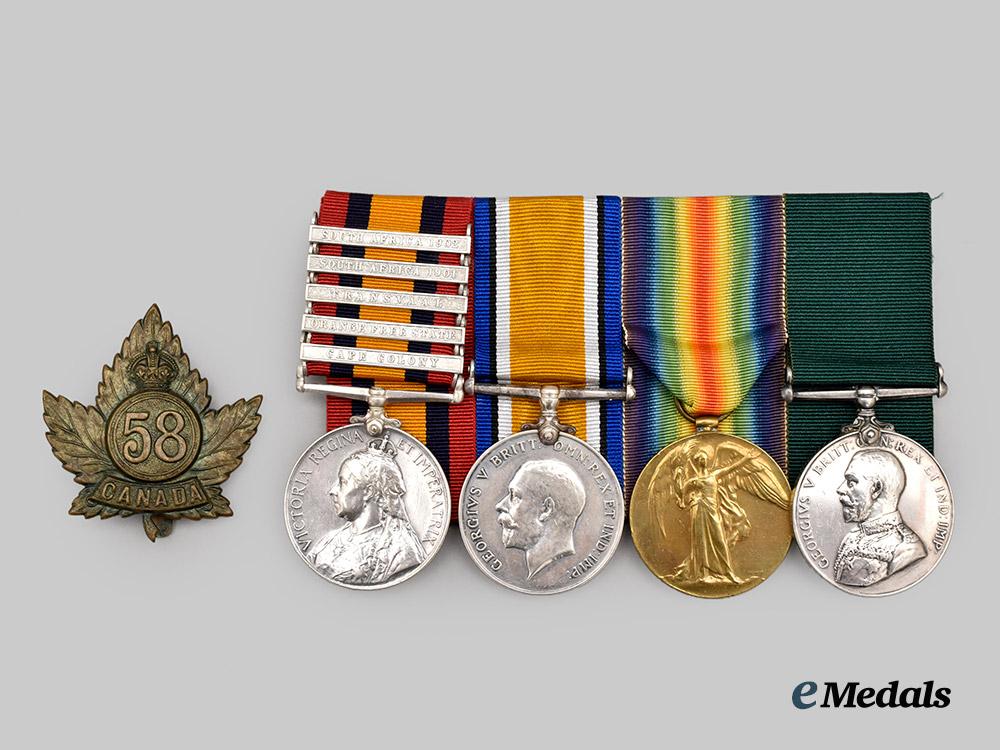
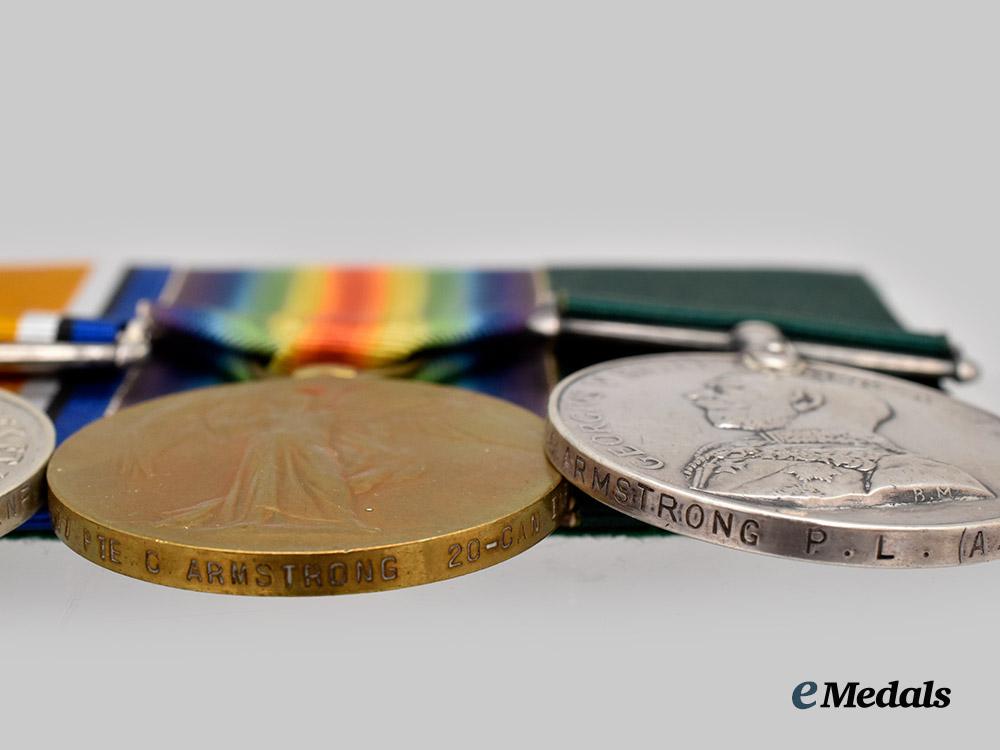
Canada, Commonwealth. A South Africa and First War Medal Bar to Pte. Armstrong
SKU: ITEM: M0694-49
Current Bid:
Your Max Bid:
Bid History:
Time Remaining:
Couldn't load pickup availability
Shipping Details
Shipping Details
eMedals offers rapid domestic and international shipping. Orders received prior to 12:00pm (EST) will be shipped on the same business day.* Orders placed on Canadian Federal holidays will be dispatched the subsequent business day. Courier tracking numbers are provided for all shipments. All items purchased from eMedals can be returned for a full monetary refund or merchandise credit, providing the criteria presented in our Terms & Conditions are met. *Please note that the addition of a COA may impact dispatch time.
Shipping Details
eMedals offers rapid domestic and international shipping. Orders received prior to 12:00pm (EST) will be shipped on the same business day.* Orders placed on Canadian Federal holidays will be dispatched the subsequent business day. Courier tracking numbers are provided for all shipments. All items purchased from eMedals can be returned for a full monetary refund or merchandise credit, providing the criteria presented in our Terms & Conditions are met. *Please note that the addition of a COA may impact dispatch time.
Description
Description
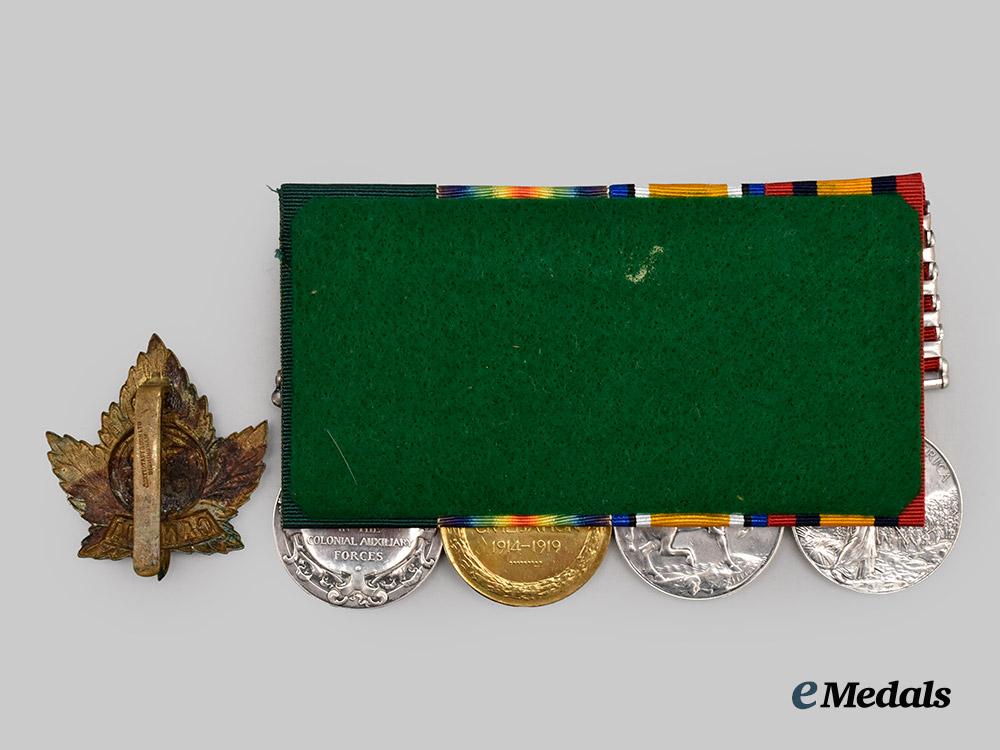
A court mounted medal bar, measuring 137 mm (w) x 87.5 mm (h), reverse bears a green felt backing, no pin, comprising four medals:
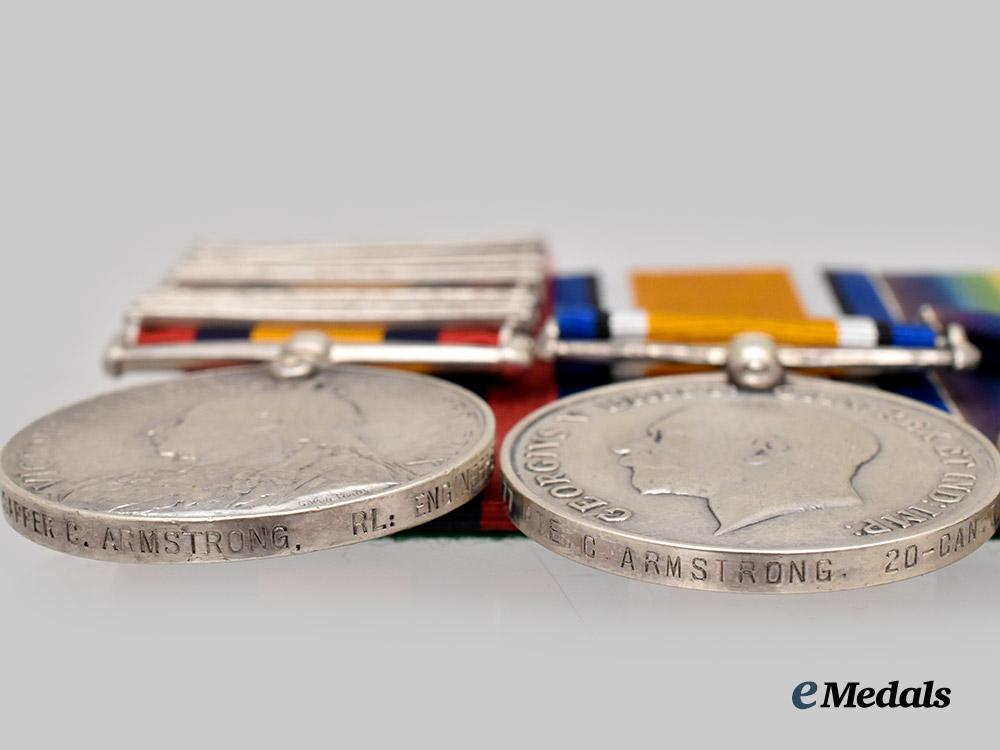
A Queen’s South Africa Medal, in silver, full size, rim impressed 8345 SAPPER C. ARMSTRONG, RL: ENGINEERS VOLS:, with clasps SOUTH AFRICA 1902, SOUTH AFRICA 1901 TRANSVAAL, ORANGE FREE STATE, CAPE COLONY, replacement ribbon, light wear, bright, extremely fine.
A British War Medal, silver, full size, rim impressed 451777 PTE. C. ARMSTRONG. 20-CAN. INF., replacement ribbon, minor marks, extremely fine.
A Victory Medal, bronze gilt, full size, rim impressed 451777 PTE. C. ARMSTRONG. 20-CAN. INF., replacement ribbon, minor contact marks, gilt intact, extremely fine.
A Colonial Auxiliary Forces Long Service Medal, in silver, full size, rim impressed SGT. C. ARMSTRONG P. L.. (A. & S. H.) OF C., replacement ribbon, light contact marks, remains in extremely fine condition.
A 58th Infantry Battalion Cap Badge, browning brass, vertical flat prong on reverse, measures 46.9 mm (w) x 52.1 mm (h), marked J.W. TIPTAFT & SONS LTD BIRMINGHAM, light wear and discolouration, near extremely fine.
Footnote: Christopher Armstrong was born in Glasgow, Scotland in 1878.
He served with the Royal Engineers in South Africa during the Boer War.
Armstrong was residing in Hamilton, Ontario with his wife Agnes, and working as a labourer (cement worker), when he enlisted with the 91st Highlanders in Niagara, on June 20, 1915. He was later transferred to the 58th Battalion (20th Battalion overseas) upon arriving in France in February 1916.
It was reported that on April 15/16 1916, at St. Eloi, a shell burst near him resulting in him being deaf and dazed for nearly three weeks. His eardrum was perforated, and he was hospitalized for shell shock for several weeks in July and August in England. He was discharged on September 1, and rejoined the unit in March 1917. On August 16, 1917, he suffered from a shell wound to the right leg, and a bayonet wound to the right knee. In January 1918, he was awarded a good conduct strip in the field.
In January 1919, he suffered from ‘debility myalgia’ and later in March from neurasthenia, and was medically unfit. He sailed back to Canada. Armstrong died in 1933 and is commemorated in Hamilton.
The 58th Battalion, Canadian Expeditionary Force (CEF), was formed in April 1915 and mobilized at Niagara-on-the-Lake, Ontario. Composed primarily of recruits from central Ontario, the battalion sailed to Great Britain in November 1915 and proceeded to France in February 1916. It was assigned to the 9th Infantry Brigade of the 3rd Canadian Division. The 58th Battalion saw extensive action on the Western Front throughout the war, participating in many of the major Canadian engagements. These included the Battle of Mount Sorrel in June 1916, the Somme offensive later that year, and the famous assault on Vimy Ridge in April 1917. The battalion also fought at Passchendaele in late 1917, and in 1918 took part in the Hundred Days Offensive, including battles at Amiens, Arras, the Drocourt-Quéant Line, and Cambrai. Like many Canadian units, the 58th earned a reputation for toughness and reliability under fire. After the Armistice in November 1918, the battalion returned to Canada and was officially disbanded in 1920.
Description
A court mounted medal bar, measuring 137 mm (w) x 87.5 mm (h), reverse bears a green felt backing, no pin, comprising four medals:
A Queen’s South Africa Medal, in silver, full size, rim impressed 8345 SAPPER C. ARMSTRONG, RL: ENGINEERS VOLS:, with clasps SOUTH AFRICA 1902, SOUTH AFRICA 1901 TRANSVAAL, ORANGE FREE STATE, CAPE COLONY, replacement ribbon, light wear, bright, extremely fine.
A British War Medal, silver, full size, rim impressed 451777 PTE. C. ARMSTRONG. 20-CAN. INF., replacement ribbon, minor marks, extremely fine.
A Victory Medal, bronze gilt, full size, rim impressed 451777 PTE. C. ARMSTRONG. 20-CAN. INF., replacement ribbon, minor contact marks, gilt intact, extremely fine.
A Colonial Auxiliary Forces Long Service Medal, in silver, full size, rim impressed SGT. C. ARMSTRONG P. L.. (A. & S. H.) OF C., replacement ribbon, light contact marks, remains in extremely fine condition.
A 58th Infantry Battalion Cap Badge, browning brass, vertical flat prong on reverse, measures 46.9 mm (w) x 52.1 mm (h), marked J.W. TIPTAFT & SONS LTD BIRMINGHAM, light wear and discolouration, near extremely fine.
Footnote: Christopher Armstrong was born in Glasgow, Scotland in 1878.
He served with the Royal Engineers in South Africa during the Boer War.
Armstrong was residing in Hamilton, Ontario with his wife Agnes, and working as a labourer (cement worker), when he enlisted with the 91st Highlanders in Niagara, on June 20, 1915. He was later transferred to the 58th Battalion (20th Battalion overseas) upon arriving in France in February 1916.
It was reported that on April 15/16 1916, at St. Eloi, a shell burst near him resulting in him being deaf and dazed for nearly three weeks. His eardrum was perforated, and he was hospitalized for shell shock for several weeks in July and August in England. He was discharged on September 1, and rejoined the unit in March 1917. On August 16, 1917, he suffered from a shell wound to the right leg, and a bayonet wound to the right knee. In January 1918, he was awarded a good conduct strip in the field.
In January 1919, he suffered from ‘debility myalgia’ and later in March from neurasthenia, and was medically unfit. He sailed back to Canada. Armstrong died in 1933 and is commemorated in Hamilton.
The 58th Battalion, Canadian Expeditionary Force (CEF), was formed in April 1915 and mobilized at Niagara-on-the-Lake, Ontario. Composed primarily of recruits from central Ontario, the battalion sailed to Great Britain in November 1915 and proceeded to France in February 1916. It was assigned to the 9th Infantry Brigade of the 3rd Canadian Division. The 58th Battalion saw extensive action on the Western Front throughout the war, participating in many of the major Canadian engagements. These included the Battle of Mount Sorrel in June 1916, the Somme offensive later that year, and the famous assault on Vimy Ridge in April 1917. The battalion also fought at Passchendaele in late 1917, and in 1918 took part in the Hundred Days Offensive, including battles at Amiens, Arras, the Drocourt-Quéant Line, and Cambrai. Like many Canadian units, the 58th earned a reputation for toughness and reliability under fire. After the Armistice in November 1918, the battalion returned to Canada and was officially disbanded in 1920.

You May Also Like
United Kingdom. A Second War British Empire Medal Miniature Group
GB8734
United Kingdom. A Fine Early 20th Century Diplomatic Miniature Group
GB8732
Canada, CEF. A Memorial Cross, 1st Canadian Mounted Rifles, Sanctuary Wood
C7782
United Kingdom. A Malaya & Korean Campaign Medal Group
GB8739
United Kingdom. A Royal Life Saving Society Medal, 1933
GB8723
-
United Kingdom. A Second War British Empire Medal Miniature Group
GB8734
Add to CartRegular price $340 USDRegular price $0 USD Sale price $340 USDUnit price / per -
United Kingdom. A Fine Early 20th Century Diplomatic Miniature Group
GB8732
Add to CartRegular price $340 USDRegular price $0 USD Sale price $340 USDUnit price / per -
Canada, CEF. A Memorial Cross, 1st Canadian Mounted Rifles, Sanctuary Wood
C7782
Add to CartRegular price $270 USDRegular price $0 USD Sale price $270 USDUnit price / per -
United Kingdom. A Malaya & Korean Campaign Medal Group
GB8739
Add to CartRegular price $405 USDRegular price $0 USD Sale price $405 USDUnit price / per -
United Kingdom. A Royal Life Saving Society Medal, 1933
GB8723
Add to CartRegular price $100 USDRegular price $0 USD Sale price $100 USDUnit price / per
Do you have a similar item you are interested in selling?
Please complete the form and our client care representatives will contact you.
Sell Item