LOADING ...
In response to evolving domestic opinion, eMedals Inc has made the conscious decision to remove the presentation of German Third Reich historical artifacts from our online catalogue. For three decades, eMedals Inc has made an effort to preserve history in all its forms. As historians and researchers, we have managed sensitive articles and materials with the greatest of care and respect for their past and present social context. We acknowledge the growing sentiments put forth by the Canadian public and have taken proactive actions to address this opinion.
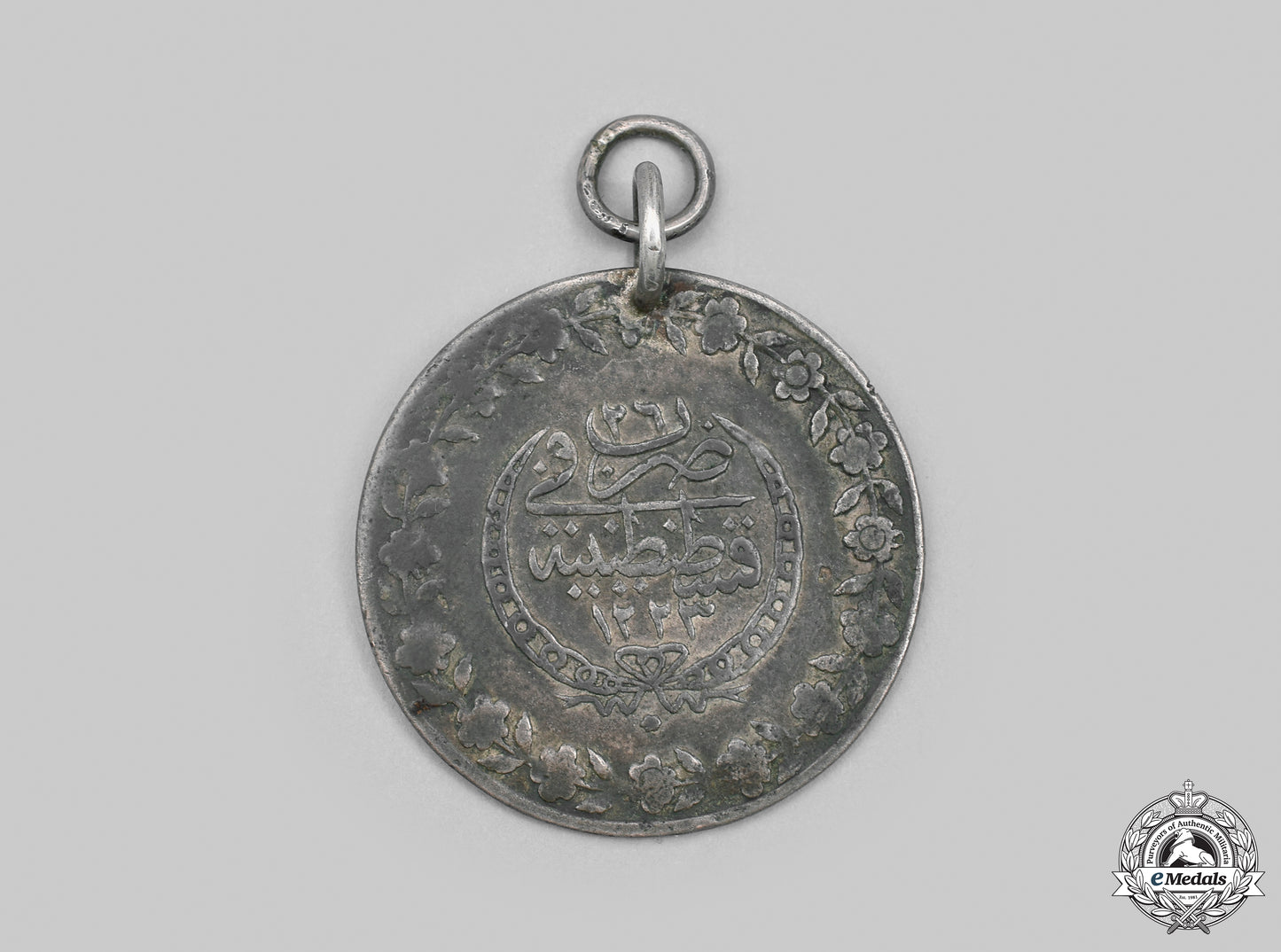
Turkey, Ottoman Empire. A Converted 5 Kurush Coin 1834
SKU: ITEM: EU18930
Current Bid:
Your Max Bid:
Bid History:
Time Remaining:
Couldn't load pickup availability
Shipping Details
Shipping Details
eMedals offers rapid domestic and international shipping. Orders received prior to 12:00pm (EST) will be shipped on the same business day.* Orders placed on Canadian Federal holidays will be dispatched the subsequent business day. Courier tracking numbers are provided for all shipments. All items purchased from eMedals can be returned for a full monetary refund or merchandise credit, providing the criteria presented in our Terms & Conditions are met. *Please note that the addition of a COA may impact dispatch time.
Shipping Details
eMedals offers rapid domestic and international shipping. Orders received prior to 12:00pm (EST) will be shipped on the same business day.* Orders placed on Canadian Federal holidays will be dispatched the subsequent business day. Courier tracking numbers are provided for all shipments. All items purchased from eMedals can be returned for a full monetary refund or merchandise credit, providing the criteria presented in our Terms & Conditions are met. *Please note that the addition of a COA may impact dispatch time.
Description
Description
In silver, obverse illustrating the Tughra of Mahmud II, reverse dated with the start date of his reign in Eastern Arabic "1223" (1808) and numbered "26" (the twenty-sixth year of his reign and date of the minting of the coin, 1834), measuring 39.2 mm in diameter, hole drilled at the top with a ring suspension added, exhibiting pitting, bruised, edge nicks, moderate surface wear, very fine.
Footnote:
1. Mahmud II (July 20, 1785 - July 1, 1839; AH1223-1255) was the 30th Sultan of the Ottoman Empire from 1808 until his death in 1839. His reign is recognized for the extensive administrative, military, and fiscal reforms he instituted, which culminated in the Decree of Tanzimat ("reorganization") that was carried out by his sons Abdulmejid I and Abdülaziz. Often described as "Peter the Great of Turkey", Mahmud's reforms included the 1826 abolition of the conservative Janissary corps, which removed a major obstacle to his and his successors' reforms in the Empire. The reforms he instituted were characterized by political and social changes, which would eventually lead to the birth of the modern Turkish Republic. Mahmud II is the last sultan who used his political (non-judgmental) execution authority. Notwithstanding his domestic reforms, Mahmud's reign was also marked by nationalist uprisings in Ottoman-ruled Serbia and Greece, leading to significant loss of territory for the Empire following the emergence of an independent Greek state. In the general structure of the Ottoman Empire, Mahmud's reign was characterized by showing major interest in Westernization; institutions, palace order, daily life, clothing, music and many other areas saw radical reform as the Ottoman Empire opened up to modernization.
2. While there are many possible causes for a coin being holed, the answer for the vast majority of holed Ottoman coins lies in the traditions of one of the most beautiful, sacred and joyous aspects of Ottoman culture: marriage. In the Ottoman Empire, few occasions were as joyous or heavily celebrated as a marriage. The only possible competitors would be the birth of a child or the circumcision of a son. Ottoman marriage customs and ceremonies were quite unique, as are many Ottoman cultural aspects, as they were a blend of the many cultures that composed the Ottoman Empire, those that preceded it such as the Byzantine Empire and some unique innovations put into place by the Ottomans themselves. It was a long standing tradition for the bride to wear jewelry and other ornamentation made up of actual circulating coinage. This is where many Ottoman coins gained their holes, from being pierced by jewellers and relatives of brides, using the money given by family and friends to the couple to make the ornaments that the bride would wear on her wedding day.
Description
In silver, obverse illustrating the Tughra of Mahmud II, reverse dated with the start date of his reign in Eastern Arabic "1223" (1808) and numbered "26" (the twenty-sixth year of his reign and date of the minting of the coin, 1834), measuring 39.2 mm in diameter, hole drilled at the top with a ring suspension added, exhibiting pitting, bruised, edge nicks, moderate surface wear, very fine.
Footnote:
1. Mahmud II (July 20, 1785 - July 1, 1839; AH1223-1255) was the 30th Sultan of the Ottoman Empire from 1808 until his death in 1839. His reign is recognized for the extensive administrative, military, and fiscal reforms he instituted, which culminated in the Decree of Tanzimat ("reorganization") that was carried out by his sons Abdulmejid I and Abdülaziz. Often described as "Peter the Great of Turkey", Mahmud's reforms included the 1826 abolition of the conservative Janissary corps, which removed a major obstacle to his and his successors' reforms in the Empire. The reforms he instituted were characterized by political and social changes, which would eventually lead to the birth of the modern Turkish Republic. Mahmud II is the last sultan who used his political (non-judgmental) execution authority. Notwithstanding his domestic reforms, Mahmud's reign was also marked by nationalist uprisings in Ottoman-ruled Serbia and Greece, leading to significant loss of territory for the Empire following the emergence of an independent Greek state. In the general structure of the Ottoman Empire, Mahmud's reign was characterized by showing major interest in Westernization; institutions, palace order, daily life, clothing, music and many other areas saw radical reform as the Ottoman Empire opened up to modernization.
2. While there are many possible causes for a coin being holed, the answer for the vast majority of holed Ottoman coins lies in the traditions of one of the most beautiful, sacred and joyous aspects of Ottoman culture: marriage. In the Ottoman Empire, few occasions were as joyous or heavily celebrated as a marriage. The only possible competitors would be the birth of a child or the circumcision of a son. Ottoman marriage customs and ceremonies were quite unique, as are many Ottoman cultural aspects, as they were a blend of the many cultures that composed the Ottoman Empire, those that preceded it such as the Byzantine Empire and some unique innovations put into place by the Ottomans themselves. It was a long standing tradition for the bride to wear jewelry and other ornamentation made up of actual circulating coinage. This is where many Ottoman coins gained their holes, from being pierced by jewellers and relatives of brides, using the money given by family and friends to the couple to make the ornaments that the bride would wear on her wedding day.

You May Also Like
Germany, Imperial. A Commemorative Reservist Stein to Drummer Friedrich Scharkenberg
G63362
Germany, RAD. A Service Cap for Leaders
G63360
Germany, Kriegsmarine. A Deck Gun Binocular, by Optische Präzisions-Werke G.m.b.H., c. 1944
G63329
Germany, Heer. A Flak/Artillery Visor Cap for Enlisted Ranks, by Clemens Wagner
G63316
Germany, Heer. A Pair of Breast Eagles for Higher Ranks
G63293
-
Germany, Imperial. A Commemorative Reservist Stein to Drummer Friedrich Scharkenberg
G63362
Add to CartRegular price $340 USDRegular price $0 USD Sale price $340 USDUnit price / per -
Germany, RAD. A Service Cap for Leaders
G63360
Add to CartRegular price $1,080 USDRegular price $0 USD Sale price $1,080 USDUnit price / per -
Germany, Kriegsmarine. A Deck Gun Binocular, by Optische Präzisions-Werke G.m.b.H., c. 1944
G63329
Add to CartRegular price $945 USDRegular price $0 USD Sale price $945 USDUnit price / per -
Germany, Heer. A Flak/Artillery Visor Cap for Enlisted Ranks, by Clemens Wagner
G63316
Add to CartRegular price $675 USDRegular price $0 USD Sale price $675 USDUnit price / per -
Germany, Heer. A Pair of Breast Eagles for Higher Ranks
G63293
Add to CartRegular price $135 USDRegular price $0 USD Sale price $135 USDUnit price / per
Do you have a similar item you are interested in selling?
Please complete the form and our client care representatives will contact you.
Sell Item