LOADING ...
In response to evolving domestic opinion, eMedals Inc has made the conscious decision to remove the presentation of German Third Reich historical artifacts from our online catalogue. For three decades, eMedals Inc has made an effort to preserve history in all its forms. As historians and researchers, we have managed sensitive articles and materials with the greatest of care and respect for their past and present social context. We acknowledge the growing sentiments put forth by the Canadian public and have taken proactive actions to address this opinion.
United States. A Revolutionary War & Historical Significant Gold Mourning Pin
SKU: ITEM: M0716-3
Buyer's Premium
Current Bid:
Your Max Bid:
Bid History:
Time Remaining:
Couldn't load pickup availability
Shipping Details
Shipping Details
eMedals offers rapid domestic and international shipping. Orders received prior to 12:00pm (EST) will be shipped on the same business day.* Orders placed on Canadian Federal holidays will be dispatched the subsequent business day. Courier tracking numbers are provided for all shipments. All items purchased from eMedals can be returned for a full monetary refund or merchandise credit, providing the criteria presented in our Terms & Conditions are met. *Please note that the addition of a COA may impact dispatch time.
Shipping Details
eMedals offers rapid domestic and international shipping. Orders received prior to 12:00pm (EST) will be shipped on the same business day.* Orders placed on Canadian Federal holidays will be dispatched the subsequent business day. Courier tracking numbers are provided for all shipments. All items purchased from eMedals can be returned for a full monetary refund or merchandise credit, providing the criteria presented in our Terms & Conditions are met. *Please note that the addition of a COA may impact dispatch time.
Description
Description
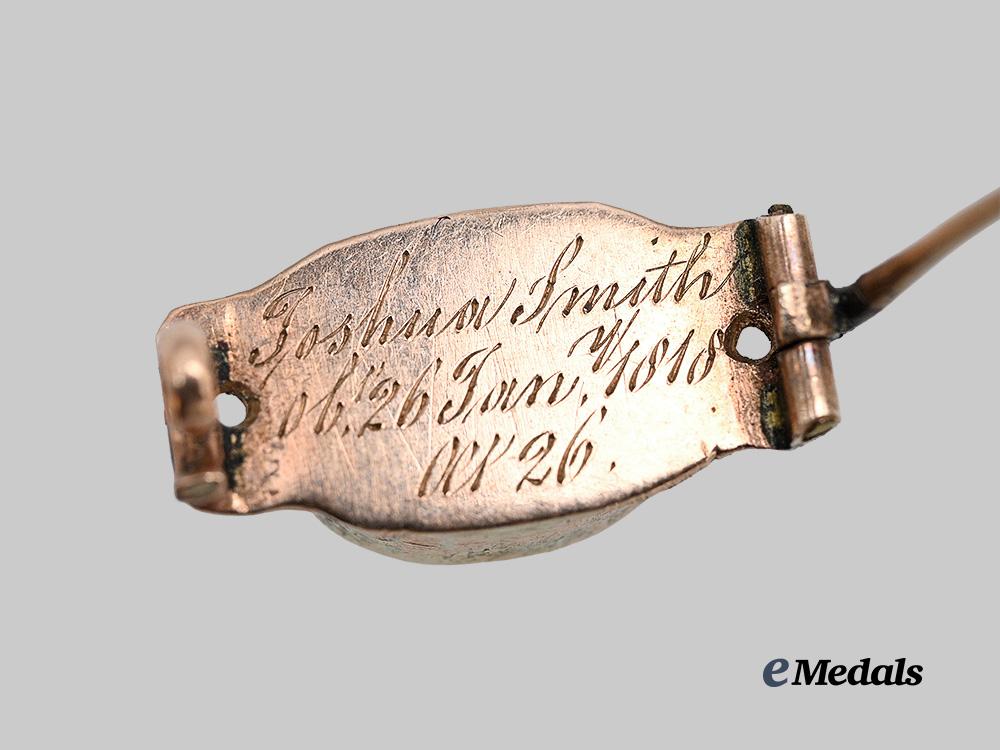
Gold Mourning Pin containing a braided section of hair, reverse finely engraved "Joshua Smith ob. 26 Jany. 1818 Oct.26." with pinback and glass lens, extremely fine.
Footnote: Joshua Hett Smith (1736–1818): Lawyer, Landowner, and Revolutionary War Figure
Joshua Hett Smith was born in 1736 into a prominent New York family and trained as a lawyer before establishing himself as a prosperous landowner along the Hudson River at Haverstraw, New York. Although sympathetic to the Patriot cause during the early years of the American Revolution, Smith's legacy became inseparably linked to one of the most infamous episodes of the war—the treason of Major General Benedict Arnold.
Smith's home, known as the Treason House, occupied a strategic location on the west bank of the Hudson River, only a short distance from the American fortress at West Point. In September 1780, Arnold selected Smith's house as the meeting place where he secretly conferred with British intelligence officer John André to finalize plans for the surrender of West Point to the British. Smith ferried André across the Hudson River to the meeting and later accompanied him on part of his overland journey after André was forced to return by land when British naval movements prevented his escape by water.
When André was captured by American militiamen carrying incriminating papers detailing Arnold's plans, the conspiracy was uncovered. Arnold escaped to British lines, but André was tried as a spy and executed. Smith was arrested on suspicion of complicity and confined for several months. He was tried by court-martial in 1781 but ultimately acquitted, largely because the prosecution could not prove that he had knowingly participated in Arnold's treason. Nevertheless, suspicion continued to surround him for the remainder of his life, and his reputation never fully recovered.
Despite his controversial role, Joshua Hett Smith occupies an important place in American Revolutionary history. His home served as the setting for the clandestine meeting that nearly altered the course of the war. Had Arnold's plan succeeded, the loss of West Point—the key American stronghold controlling the Hudson River—could have divided New England from the southern colonies and dramatically strengthened Britain's military position. The failure of the conspiracy became one of the defining intelligence successes of the Revolution and cemented Arnold's name as synonymous with treason in American history.
Smith spent his later years attempting to defend his conduct. In 1808 he published An Authentic Narrative of the Causes Which Led to the Death of Major André, providing his account of the conspiracy and insisting that he had been an unwitting participant rather than a conspirator. He died in 1818.
A gold mourning pin containing a lock of Joshua Hett Smith's hair was almost certainly produced as a personal memorial rather than a public tribute. Hair jewelry was a common form of remembrance in the late eighteenth and early nineteenth centuries, especially among close family and intimate friends. Such a pin would most likely have been worn by his widow, daughter, sister, or another close female relative during the period of mourning following his death. Less commonly, a devoted friend or family associate might also have worn the piece as a keepsake. Given Smith's controversial reputation, it is unlikely that such a pin was intended for broad public display; instead, it would have served as a deeply personal remembrance of a family member whose life had become entwined with one of the most dramatic episodes of the American Revolution.
Description
Gold Mourning Pin containing a braided section of hair, reverse finely engraved "Joshua Smith ob. 26 Jany. 1818 Oct.26." with pinback and glass lens, extremely fine.
Footnote: Joshua Hett Smith (1736–1818): Lawyer, Landowner, and Revolutionary War Figure
Joshua Hett Smith was born in 1736 into a prominent New York family and trained as a lawyer before establishing himself as a prosperous landowner along the Hudson River at Haverstraw, New York. Although sympathetic to the Patriot cause during the early years of the American Revolution, Smith's legacy became inseparably linked to one of the most infamous episodes of the war—the treason of Major General Benedict Arnold.
Smith's home, known as the Treason House, occupied a strategic location on the west bank of the Hudson River, only a short distance from the American fortress at West Point. In September 1780, Arnold selected Smith's house as the meeting place where he secretly conferred with British intelligence officer John André to finalize plans for the surrender of West Point to the British. Smith ferried André across the Hudson River to the meeting and later accompanied him on part of his overland journey after André was forced to return by land when British naval movements prevented his escape by water.
When André was captured by American militiamen carrying incriminating papers detailing Arnold's plans, the conspiracy was uncovered. Arnold escaped to British lines, but André was tried as a spy and executed. Smith was arrested on suspicion of complicity and confined for several months. He was tried by court-martial in 1781 but ultimately acquitted, largely because the prosecution could not prove that he had knowingly participated in Arnold's treason. Nevertheless, suspicion continued to surround him for the remainder of his life, and his reputation never fully recovered.
Despite his controversial role, Joshua Hett Smith occupies an important place in American Revolutionary history. His home served as the setting for the clandestine meeting that nearly altered the course of the war. Had Arnold's plan succeeded, the loss of West Point—the key American stronghold controlling the Hudson River—could have divided New England from the southern colonies and dramatically strengthened Britain's military position. The failure of the conspiracy became one of the defining intelligence successes of the Revolution and cemented Arnold's name as synonymous with treason in American history.
Smith spent his later years attempting to defend his conduct. In 1808 he published An Authentic Narrative of the Causes Which Led to the Death of Major André, providing his account of the conspiracy and insisting that he had been an unwitting participant rather than a conspirator. He died in 1818.
A gold mourning pin containing a lock of Joshua Hett Smith's hair was almost certainly produced as a personal memorial rather than a public tribute. Hair jewelry was a common form of remembrance in the late eighteenth and early nineteenth centuries, especially among close family and intimate friends. Such a pin would most likely have been worn by his widow, daughter, sister, or another close female relative during the period of mourning following his death. Less commonly, a devoted friend or family associate might also have worn the piece as a keepsake. Given Smith's controversial reputation, it is unlikely that such a pin was intended for broad public display; instead, it would have served as a deeply personal remembrance of a family member whose life had become entwined with one of the most dramatic episodes of the American Revolution.

You May Also Like
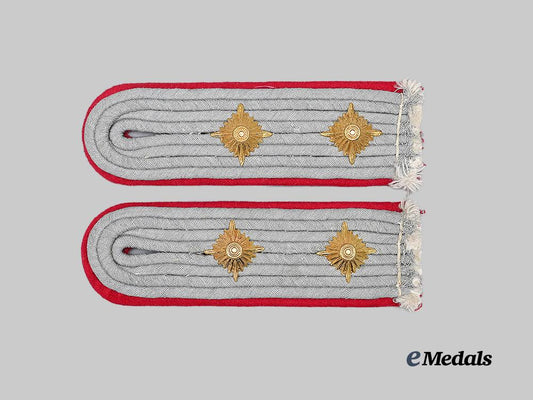
Germany, Heer. A Set of General Staff Hauptmann Shoulder Boards
M0676-458
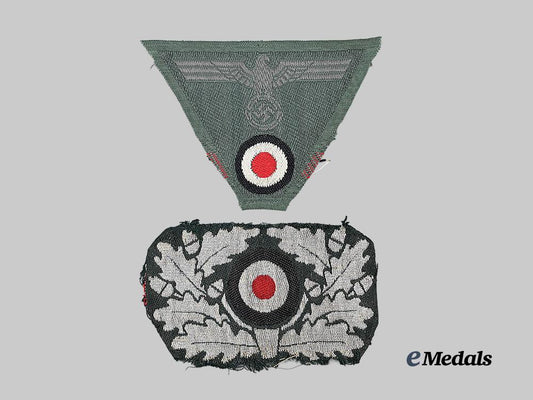
Germany, Heer. A Pair of Cap Insignia for Enlisted and Officer Ranks
M0676-143
United States. A Lot of Insignia & Badges
W8765
Saxony, Kingdom. An Army Belt Buckle for Enlisted Ranks
G63563
Germany, Wehrmacht. A 1939 Iron Cross I Class, Modified for Post-War Wear, by Wilhelm Deumer
G63561
-
Germany, Heer. A Set of General Staff Hauptmann Shoulder Boards
M0676-458
Add to CartRegular price $205 USDRegular price $0 USD Sale price $205 USDUnit price / per -
Germany, Heer. A Pair of Cap Insignia for Enlisted and Officer Ranks
M0676-143
Add to CartRegular price $205 USDRegular price $0 USD Sale price $205 USDUnit price / per -
United States. A Lot of Insignia & Badges
W8765
Add to CartRegular price $65 USDRegular price $0 USD Sale price $65 USDUnit price / per -
Saxony, Kingdom. An Army Belt Buckle for Enlisted Ranks
G63563
Add to CartRegular price $205 USDRegular price $0 USD Sale price $205 USDUnit price / per -
Germany, Wehrmacht. A 1939 Iron Cross I Class, Modified for Post-War Wear, by Wilhelm Deumer
G63561
Add to CartRegular price $135 USDRegular price $0 USD Sale price $135 USDUnit price / per
Do you have a similar item you are interested in selling?
Please complete the form and our client care representatives will contact you.
Sell Item