LOADING ...
In response to evolving domestic opinion, eMedals Inc has made the conscious decision to remove the presentation of German Third Reich historical artifacts from our online catalogue. For three decades, eMedals Inc has made an effort to preserve history in all its forms. As historians and researchers, we have managed sensitive articles and materials with the greatest of care and respect for their past and present social context. We acknowledge the growing sentiments put forth by the Canadian public and have taken proactive actions to address this opinion.
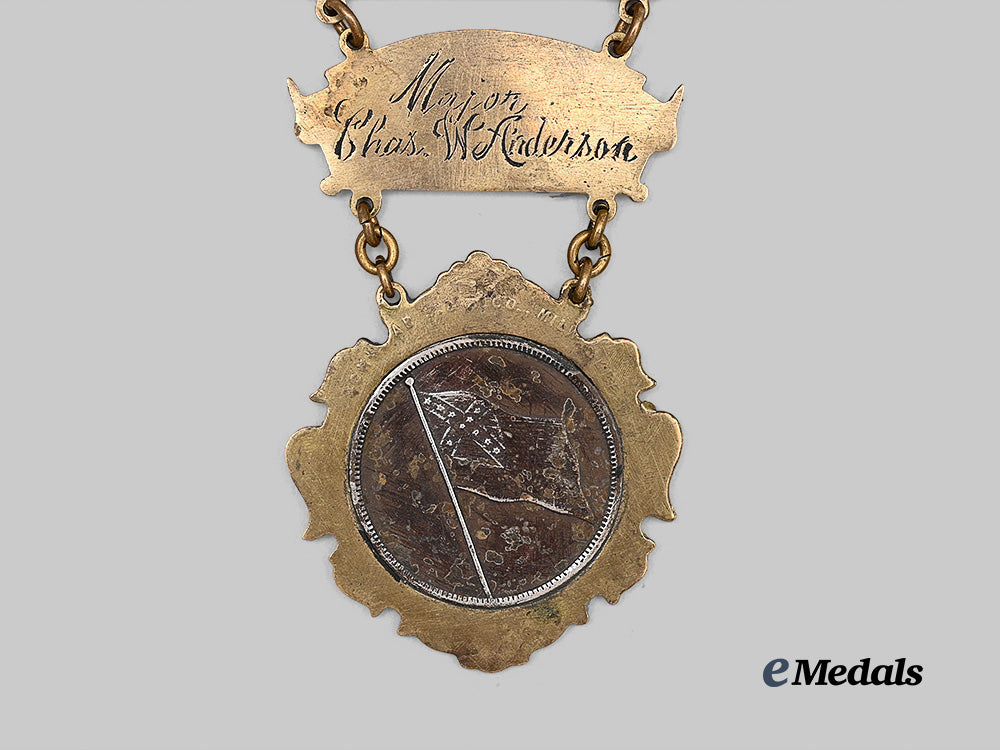
United States. A Forrest Cavalry Corps Member Badge, to Major Charles W. Anderson
SKU: ITEM: M0716-7
Buyer's Premium
Current Bid:
Your Max Bid:
Bid History:
Time Remaining:
Couldn't load pickup availability
Shipping Details
Shipping Details
eMedals offers rapid domestic and international shipping. Orders received prior to 12:00pm (EST) will be shipped on the same business day.* Orders placed on Canadian Federal holidays will be dispatched the subsequent business day. Courier tracking numbers are provided for all shipments. All items purchased from eMedals can be returned for a full monetary refund or merchandise credit, providing the criteria presented in our Terms & Conditions are met. *Please note that the addition of a COA may impact dispatch time.
Description
Description
A scarce badge in bronze, with a silver centre featuring the bust of General B.Forrest, with two suspension bars, reverse with worn makers mark Schwaabs & S. / Milwaukee, privately engraved "Major Chas. W. Anderson" on middle suspension bar, measuring 95.90 mm (h) x 47.61 (w - at upper suspension), 31.6 grams, remains good/fine and extremely scarce.
Footnote: Forrest was one of the Confederacy's best-known cavalry commanders. A largely self-taught military leader, he became famous for aggressive raids, rapid movement, reconnaissance and attacks against Union forces and supply lines. His cavalry operated in the Western Theater, particularly in Tennessee, Mississippi and surrounding areas. Forrest's commands fought in numerous engagements, including the campaigns around Chickamauga and later operations against Union communications and garrisons
Major Charles W. Anderson was a Confederate staff officer, serving as Forrest's adjutant and inspector general, Anderson became a trusted aide, military secretary and personal confidant. His abilities as a writer and administrator helped translate Forrest's battlefield decisions and military intentions into formal orders and reports. Following the war, he remained connected to his former commander and became active in the organizations that preserved the memory of Forrest's cavalrymen.
Early life and the outbreak of war: Anderson was living in Tennessee when the American Civil War began in 1861. Accounts of his life describe him as initially reluctant to take sides, preferring neutrality rather than immediate commitment to either the Union or Confederacy.
His position reportedly changed after Union troops looted and damaged his home while he was away assisting casualties at a local hospital. The destruction, including damage to family portraits, helped turn him against the Federal occupation. He subsequently joined the Confederate cause, initially serving in the transportation department before transferring to Forrest's command.
Service with Nathan Bedford Forrest, 1862–1865: Anderson's talents brought him into the inner circle of Forrest's headquarters. He served as an adjutant and inspector general, handling correspondence, preparing orders and assisting with the administration of the cavalry command. He was valued not simply as a clerk but as an officer who understood Forrest's temperament and could communicate his intentions effectively.
His service placed him in the midst of some of the Western Theater's most important cavalry operations, including the campaigns associated with the battles of Chickamauga, Fort Pillow and Selma.
One of the most significant episodes of his service was the Confederate capture of Fort Pillow, Tennessee, in April 1864. The battle became notorious for the killing of Union troops, including African American soldiers, after Confederate forces overran the position. Anderson was associated with Forrest's command during this campaign and later wrote about the events at Fort Pillow. His account is valuable as testimony from a participant, but it must be considered alongside Union testimony and other historical evidence when assessing responsibility for the killings.
Anderson's greatest contribution may have been his work behind the scenes. Forrest was renowned for his aggressive battlefield leadership, but a cavalry corps also required accurate orders, reports and coordination. Anderson helped provide that administrative and literary support.
Anderson is particularly associated with the preparation of Forrest's farewell address to his troops in May 1865, following the Confederacy's defeat. The address acknowledged that the Confederate cause had failed and urged the men to return to civilian life, obey the law and put aside personal animosities.
The address is an important document in the history of Forrest's command. Anderson's role in preparing it illustrates how he helped shape the written record of a commander who was not primarily known for formal prose.
After the Civil War: Following the surrender, Anderson remained close to Forrest. According to a published recollection of their last meeting in 1877, Anderson visited his former commander and was struck by a marked change in Forrest's manner. Forrest attributed this change to his renewed Christian faith. The anecdote offers a glimpse of the personal relationship that survived their military service.
Anderson subsequently returned to civilian life in Tennessee. Biographical accounts describe him as working in the railroad industry and raising a family. He also continued to write and speak about the war, contributing recollections of Forrest's campaigns and participating in Confederate veterans' activities. His writings became a source for later historians researching Forrest and his cavalry.
Anderson died in 1908. His death came during the period when Confederate veterans were organizing reunions, publishing memoirs and establishing commemorative associations to preserve the identities of their wartime units.

You May Also Like
Germany, Heer. A Set of Visor Cap Insignia for Enlisted Ranks
G64600
Serbia, Kingdom. An Order of St. Sava, III Class Commander
EU25484
Russia, Imperial. An Order of Saint Andrew, Center Medallion of the Star, in Gold , Silver and "Diamonds"
EU25479
Prussia, Kingdom. A Rare Order of St. John, Knight’s Cross, c. 1900
G64575
Germany, Third Reich. A Set of Land Customs Visor Cap Insignia for Enlisted Ranks
G64569
-
Germany, Heer. A Set of Visor Cap Insignia for Enlisted Ranks
G64600
Add to CartRegular price $135 USDRegular price $0 USD Sale price $135 USDUnit price / per -
Serbia, Kingdom. An Order of St. Sava, III Class Commander
EU25484
Add to CartRegular price $475 USDRegular price $0 USD Sale price $475 USDUnit price / per -
Russia, Imperial. An Order of Saint Andrew, Center Medallion of the Star, in Gold , Silver and "Diamonds"
EU25479
Add to CartRegular price $14,500 USDRegular price $0 USD Sale price $14,500 USDUnit price / per -
Prussia, Kingdom. A Rare Order of St. John, Knight’s Cross, c. 1900
G64575
Add to CartRegular price $1,750 USDRegular price $0 USD Sale price $1,750 USDUnit price / per -
Germany, Third Reich. A Set of Land Customs Visor Cap Insignia for Enlisted Ranks
G64569
Add to CartRegular price $205 USDRegular price $0 USD Sale price $205 USDUnit price / per
Do you have a similar item you are interested in selling?
Please complete the form and our client care representatives will contact you.
Sell Item