LOADING ...
In response to evolving domestic opinion, eMedals Inc has made the conscious decision to remove the presentation of German Third Reich historical artifacts from our online catalogue. For three decades, eMedals Inc has made an effort to preserve history in all its forms. As historians and researchers, we have managed sensitive articles and materials with the greatest of care and respect for their past and present social context. We acknowledge the growing sentiments put forth by the Canadian public and have taken proactive actions to address this opinion.
Germany, Imperial. A Sailor’s Cap for a Crewman of the SMS Fürst Bismarck, Owner-Attributed Example
SKU: ITEM: G63577
Buyer's Premium
Current Bid:
Your Max Bid:
Bid History:
Time Remaining:
Couldn't load pickup availability
Shipping Details
Shipping Details
eMedals offers rapid domestic and international shipping. Orders received prior to 12:00pm (EST) will be shipped on the same business day.* Orders placed on Canadian Federal holidays will be dispatched the subsequent business day. Courier tracking numbers are provided for all shipments. All items purchased from eMedals can be returned for a full monetary refund or merchandise credit, providing the criteria presented in our Terms & Conditions are met. *Please note that the addition of a COA may impact dispatch time.
Shipping Details
eMedals offers rapid domestic and international shipping. Orders received prior to 12:00pm (EST) will be shipped on the same business day.* Orders placed on Canadian Federal holidays will be dispatched the subsequent business day. Courier tracking numbers are provided for all shipments. All items purchased from eMedals can be returned for a full monetary refund or merchandise credit, providing the criteria presented in our Terms & Conditions are met. *Please note that the addition of a COA may impact dispatch time.
Description
Description
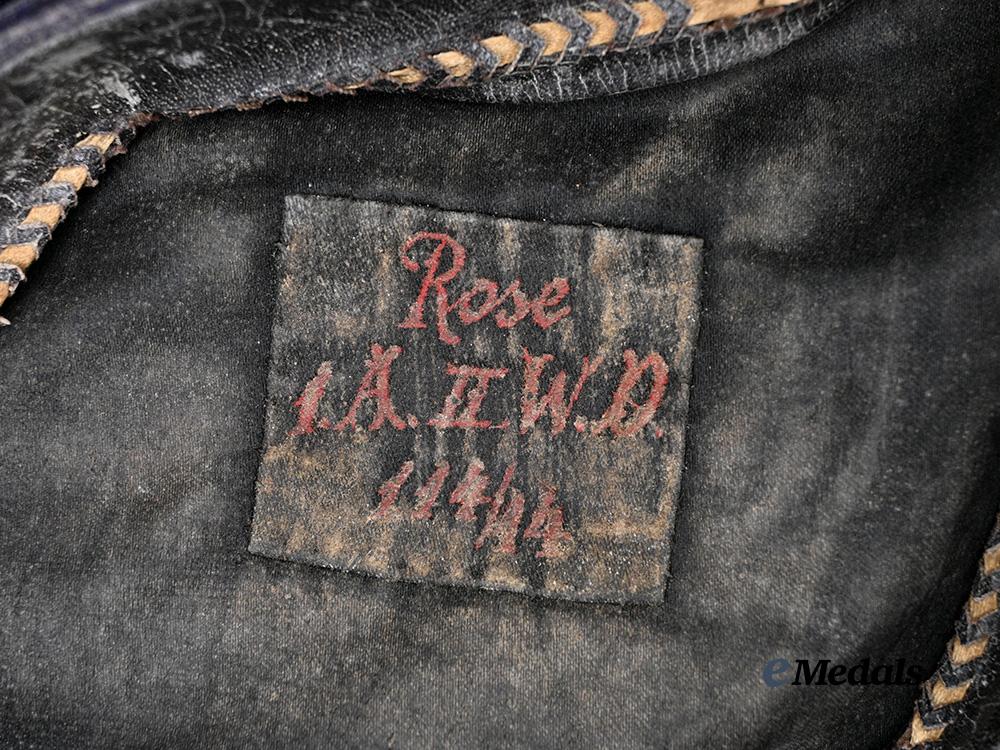
(Kaiserliche Marine dunkelblaue Tellermütze für Mannschaften der SMS Fürst Bismarck). A very well-preserved Imperial Navy sailor’s cap, constructed of dark blue wool. It features reinforced side walls surrounded on the exterior by a tally ribbon which bears a machine-embroidered silver aluminum flat wire inscription of “S.M.S. FUERST BISMARCK”, with the ribbon carefully wrapped around the back where it extends down over the wearer’s neck, secured in position with threaded stitching. Pinned onto the peak is a non-magnetic metal tri-colour cockade, measuring 20 mm in diameter. The interior is fully encompassed by a black rayon liner, while a wide black leather sweatband surrounds the interior of the side walls. Stitched onto the crown is a label bearing a red embroidered owner’s surname of “ROSE”, above an inscription of “1. A> II. W.D. 114/44”. Otherwise unmarked, the cap measures approximately 24 cm in diameter. Minor soiling is visible to the base cloth of both the interior and exterior, while the former shows moderate material fatigue consistent with both age and wear. This otherwise remarkably well-presented and owner-attributed sailor’s hat remains in an overall better than very fine condition.
Footnote: The Imperial German armored cruiser SMS Fürst Bismarck was the first armored cruiser built for the Imperial German Navy. Laid down at the Kaiserliche Werft in Kiel in 1897, launched on 25 September 1897, and commissioned on 1 April 1900, she was designed to serve as the flagship of Germany's expanding overseas naval presence. Named in honor of Chancellor Otto von Bismarck, the ship displaced over 10,000 tons and was armed with four 24 cm (9.4-inch) guns in twin turrets, supported by a powerful secondary battery. Shortly after entering service, Fürst Bismarck was dispatched to the German East Asia Squadron, where she relieved the protected cruiser Kaiser as flagship. Based at Tsingtao in China, she played a prominent role in protecting German colonial interests in East Asia, particularly during the aftermath of the Boxer Rebellion, conducting patrols, diplomatic visits, and showing the flag throughout the region until she was relieved in 1909.
Upon returning to Germany, Fürst Bismarck was no longer considered suitable for front-line service, as rapid advances in naval technology had rendered her obsolete. She underwent modernization between 1909 and 1910 before serving primarily as a torpedo training ship and later with the Naval Inspectorate. At the outbreak of the First World War, there were brief considerations to reactivate her for coastal defense, but her age, limited speed, and outdated design prevented any meaningful operational employment. Instead, she remained in secondary duties for the duration of the war, serving as an administrative and accommodation ship before being decommissioned after the conflict. Stricken from the naval register in 1919, Fürst Bismarck was sold for scrapping and broken up in Rendsburg in 1920, ending the career of the pioneering vessel that had marked Germany's first true attempt at an ocean-going armored cruiser.
Description
(Kaiserliche Marine dunkelblaue Tellermütze für Mannschaften der SMS Fürst Bismarck). A very well-preserved Imperial Navy sailor’s cap, constructed of dark blue wool. It features reinforced side walls surrounded on the exterior by a tally ribbon which bears a machine-embroidered silver aluminum flat wire inscription of “S.M.S. FUERST BISMARCK”, with the ribbon carefully wrapped around the back where it extends down over the wearer’s neck, secured in position with threaded stitching. Pinned onto the peak is a non-magnetic metal tri-colour cockade, measuring 20 mm in diameter. The interior is fully encompassed by a black rayon liner, while a wide black leather sweatband surrounds the interior of the side walls. Stitched onto the crown is a label bearing a red embroidered owner’s surname of “ROSE”, above an inscription of “1. A> II. W.D. 114/44”. Otherwise unmarked, the cap measures approximately 24 cm in diameter. Minor soiling is visible to the base cloth of both the interior and exterior, while the former shows moderate material fatigue consistent with both age and wear. This otherwise remarkably well-presented and owner-attributed sailor’s hat remains in an overall better than very fine condition.
Footnote: The Imperial German armored cruiser SMS Fürst Bismarck was the first armored cruiser built for the Imperial German Navy. Laid down at the Kaiserliche Werft in Kiel in 1897, launched on 25 September 1897, and commissioned on 1 April 1900, she was designed to serve as the flagship of Germany's expanding overseas naval presence. Named in honor of Chancellor Otto von Bismarck, the ship displaced over 10,000 tons and was armed with four 24 cm (9.4-inch) guns in twin turrets, supported by a powerful secondary battery. Shortly after entering service, Fürst Bismarck was dispatched to the German East Asia Squadron, where she relieved the protected cruiser Kaiser as flagship. Based at Tsingtao in China, she played a prominent role in protecting German colonial interests in East Asia, particularly during the aftermath of the Boxer Rebellion, conducting patrols, diplomatic visits, and showing the flag throughout the region until she was relieved in 1909.
Upon returning to Germany, Fürst Bismarck was no longer considered suitable for front-line service, as rapid advances in naval technology had rendered her obsolete. She underwent modernization between 1909 and 1910 before serving primarily as a torpedo training ship and later with the Naval Inspectorate. At the outbreak of the First World War, there were brief considerations to reactivate her for coastal defense, but her age, limited speed, and outdated design prevented any meaningful operational employment. Instead, she remained in secondary duties for the duration of the war, serving as an administrative and accommodation ship before being decommissioned after the conflict. Stricken from the naval register in 1919, Fürst Bismarck was sold for scrapping and broken up in Rendsburg in 1920, ending the career of the pioneering vessel that had marked Germany's first true attempt at an ocean-going armored cruiser.

You May Also Like
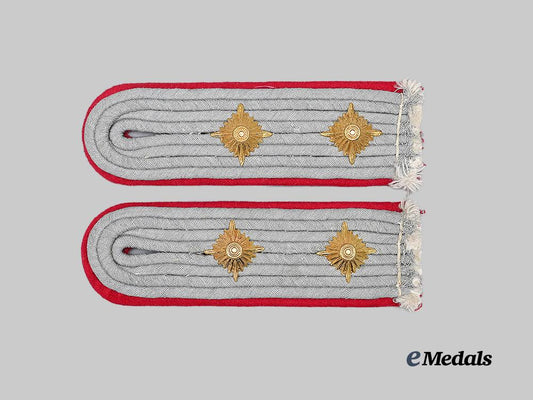
Germany, Heer. A Set of General Staff Hauptmann Shoulder Boards
M0676-458
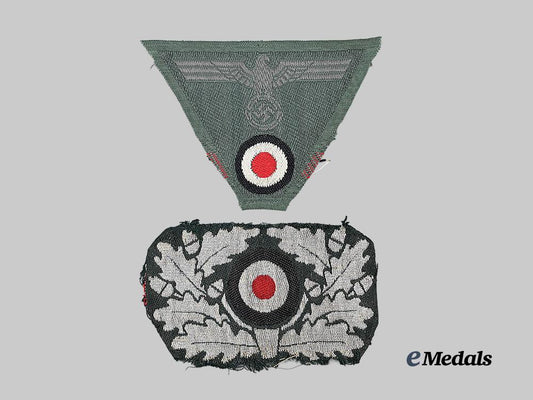
Germany, Heer. A Pair of Cap Insignia for Enlisted and Officer Ranks
M0676-143
United States. A Lot of Insignia & Badges
W8765
Saxony, Kingdom. An Army Belt Buckle for Enlisted Ranks
G63563
Germany, Wehrmacht. A 1939 Iron Cross I Class, Modified for Post-War Wear, by Wilhelm Deumer
G63561
-
Germany, Heer. A Set of General Staff Hauptmann Shoulder Boards
M0676-458
Add to CartRegular price $205 USDRegular price $0 USD Sale price $205 USDUnit price / per -
Germany, Heer. A Pair of Cap Insignia for Enlisted and Officer Ranks
M0676-143
Add to CartRegular price $205 USDRegular price $0 USD Sale price $205 USDUnit price / per -
United States. A Lot of Insignia & Badges
W8765
Add to CartRegular price $65 USDRegular price $0 USD Sale price $65 USDUnit price / per -
Saxony, Kingdom. An Army Belt Buckle for Enlisted Ranks
G63563
Add to CartRegular price $205 USDRegular price $0 USD Sale price $205 USDUnit price / per -
Germany, Wehrmacht. A 1939 Iron Cross I Class, Modified for Post-War Wear, by Wilhelm Deumer
G63561
Add to CartRegular price $135 USDRegular price $0 USD Sale price $135 USDUnit price / per
Do you have a similar item you are interested in selling?
Please complete the form and our client care representatives will contact you.
Sell Item